Showing posts with label churches. Show all posts

Tuesday, January 10, 2012

In honor of Joan of Arc's 600th birthday

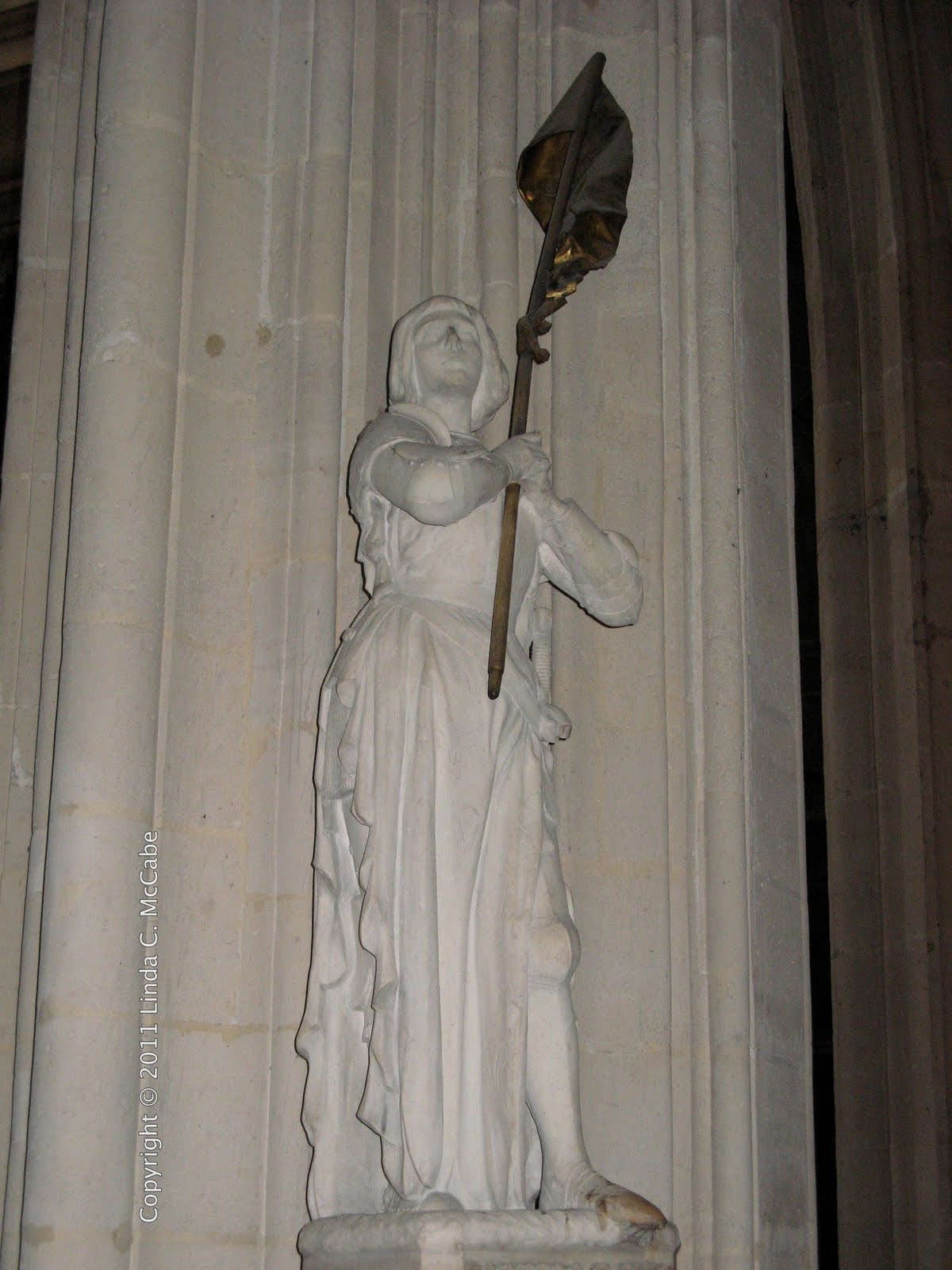
Jeanne d'Arc in the church in Saint-Antonin-Noble-Val

Joan of Arc, or Jeanne d'Arc, was born on January 6, 1412. In honor of the recent six hundredth anniversary of her birth, I present my blog readers with pictures of Jeanne d'Arc I took while on my two research trips that I took in France.

She is revered for her courage in battle defending the nation of France against the English in the "Hundred Years War" and for her faith in God.

Jeanne d'Arc is one of the patron saints of France and is a source of nationalist pride. I saw images of Jeanne d'Arc almost everywhere in France. I have come to the belief that every French village or town will have at least one image of Jeanne d'Arc. This led me to going on my own private scavenger hunt as I entered all the various cathedrales and churches.

My mission was to find her.

Sometimes she was easy to spot while other times she hid in plain sight. Here she is above the doorway and under the rose window of the church in Saint-Antonin-Noble-Val. (The first photo at the top of this post shows the close up of her.)


Here she is in the most famous church of all of France.

Cathédrale Notre Dame in Paris

I had forgotten about the famous gold statue of Jeanne d'Arc in Paris near the Place des Pyramids, and did not get my own photo of this iconic statue. I chastised myself as I watched the last day of the Tour de France and watched the cyclists pass by her multiple times.

Thankfully there is a photo posted on Wikipedia with full privileges to be in the public domain, so here is a picture of that famous golden girl.

Another representation of Jeanne d'Arc I found in Paris was in Saint-Germain-l'Auxerrois near the Louvre.

Saint-Germaine-l'Auxerrois

As I was going through my photos I discovered some duplications of statues. This same style appears in church in a small hilltop village in the Midi-Pyrenees.

-->
Église Saint Corneille in Puycelsi

And again, this time with a golden flag in Cahors. The names behind her are the men from Cahors who gave their lives in the great wars of the twentieth century.


-->
Cathédrale Saint-Étienne de Cahors

Now with a slight twist, she is holding a stone flag.

Basilique des Saints Nazaire et Celse in Carcassonne

Here is a painted version that I rather like.

-->
Église Saint Martin de Caniac-du-Causse

I also found a stained glass representation. Here she is in Amboise at the small church where Leonardo di Vinci is buried.

small church near Chateau Amboise

Then we have a wooden statue of Jeanne d'Arc which is now in the cathedral treasury in Reims. It is probably my least favorite of all the representations of Joan. She looks oh so stiff and lifeless.

Cathedral treasury in Reims


Inside the cathedral itself are mentions of her historic visit to Reims when she escorted Charles VII for his coronation.

And then across from the cathedral is a statue with Jeanne d'Arc appearing to be in the midst of battle.

Cathédrale Notre Dame de Reims

Jeanne d'Arc inspired not only the French, but she also inspired the Italian poets Matteo Maria Boiardo and Ludovico Ariosto. They patterned their heroine Bradamante after her. Both women were given the nickname "The Maid," rode on a white horse and wound up cropping their hair.

Thankfully, Bradamante did not suffer Jeanne d'Arc's fate of being persecuted, arrested, and executed as a heretic. Another major difference was that Bradamante was respected by her king and was not looked at as a threat. It also helps that Charlemagne was coronated long before his warrior niece was born.

Part of my fascination with Jeanne d'Arc is her iconic representation of a woman warrior while still projecting her humanity as well as femininity.

I wish that I had found images of Bradamante as a French heroine throughout France, but instead had to settle for Jeanne d'Arc. In another post, I shall share with you the images of Athena I found throughout France showing more examples of the archetype of the warrior woman.

I want to thank Jeff Sypeck for cluing me into this important anniversary while showing that a statue of Jeanne d'Arc in Washington, D.C., (a duplicate of the one outside Reims Cathedral), has been restored to her full glory with a new sword and a good scrub.

If you have any thoughts about Joan of Arc I would love to hear them. Even if you happen to believe, like those excellent dudes Bill and Ted, that she used to be Noah's wife.

Edited to add: I now have a board on Pinterest dedicated to Jeanne d'Arc (or Jehanne). It is ever expanding with images of this amazing saint.


http://lcmccabe.blogspot.com/2012/01/in-honor-of-joan-of-arcs-600th-birthday.html

Monday, August 29, 2011

Washington National Cathedral damaged by recent earthquake

Since my last post about the 800th anniversary of the Reims Cathedrale in France, a large 5.8 magnitude earthquake struck Virginia and among the structures damaged was the Washington National Cathedral.

My friend Jeff Sypeck lives in Washington, D.C. and he regularly posts pictures on his blog taken from the cathedral. Jeff specializes in showing pictures of gargoyles and pairing them with poems. Last week one of his blog posts discussed the damage to the cathedral and included a link to a fundraising plea to help repair the damages caused by the quake.

Last summer my family visited Washington, D.C. and we were fortunate to spend an hour in that magnificent church. In trying to help raise awareness of the the cathedral's need to raise funds, I decided I should share a few of the pictures I took with my blog readers. I enjoy gargoyles and statues, but after being in many cathedrals during my travels, I have found that my eye is drawn more to stained glass and the colors created within the churches.

Here is one where my flash was employed.


It is nice, but I discovered that stained glass windows look more dramatic when you turn the flash off.


I also like seeing the light as it is observed at an angle.


This next photo was taken in the early afternoon and I love that one stained glass window projects a ray of intense scarlet light in the middle of the nave.


This link shows the damage suffered by the earthquake, and also includes how you can help. The cost is expected to be in the millions, and every donation of any amount will help.

After visiting the cathedral, my family was fortunate to be able to meet and have a delightful dinner with Jeff Sypeck. I had corresponded by email with Jeff for several years about Charlemagne and medievalism, writing, etc., and it was nice to be able to finally meet him.


If you can, please try to help out one of my favorite medievalists whose favorite local medievalist site needs help.

Thanks,

Linda

Saturday, April 11, 2009

Guest blogging on The Midnight Shift

My friend Lee Lofland asked me to share some of my France photos for his blog's regular feature "Weekend Road Trip." Today I have a few photos from my trip in Paris, including some from Notre Dame Cathedrale and the Louvre.

You can find that post here.

Tuesday, October 14, 2008

Carcassonne, Basilica of Saints Nazarius and Celsus


In the last installment of my travelogue series, I promised to blog on the church in the medieval walled city of Carcassonne. I wanted to do that separately since I had enough material and pictures to warrant its own post.

The church goes by a few different names. Here is the sign posted outside its entrance declaring that it is the Basilique des Saints Nazaire et Celse.


The English language handout I acquired inside gives the name of the Basilica of Saints Nazarius and Celsus. Unfortunately they did not have anything detailing the stories of those saints, but I found a lengthy tale online from a Catholic forum. Another online source has Saint Nazarius as being an abbot during the time of Clotaire and is said to have "attacked the heathendom on the southern coast of France."

The handout suggests that the earliest church on that site was built during the 6th century during the "reign of Theodoric, regent for the Kingdom of the Wisigoths (sic)." It then states that the first written mention of this church was in 925 when Bishop Gimer was transfering the "Episcopal See from St. Mary and Savior's church in the surrounding country, to the church of St. Nazaire with the city walls."

The church has been renovated many times and it is said Pope Urban II stayed in Carcassonne for five days in June 1096 after having made his infamous call for the crusades in Clermont. While in Carcassonne, he blessed the materials that were used for the Romanesque building.

The plan called for a single nave, 2 side aisles, an apse with 3 chapels and the transept. The Romaneque nave adopts a disposition frequently observed in churches of the Bas-Languedoc: Barrel vaulting with doubled arches (nave), and barrel vaulting again for the especially narrow side aisles. The 2 side vaults act as buttresses for the central vault.

Here you can see the narrow barrel vaults on the side aisles.


The handout also points out that visitors should note the alternating round and squared columns.


The history of France, and particularly the south of France, is of a series of conquests. After the defeat of Carcassonne by Simon de Montfort, the king of France wanted this Romanesque church to be replaced with a Gothic one. However, the funds ran low and rather than tear down the entire structure, it was amended.

Here is my favorite picture as it shows the seams of where the pointed Gothic arches meet the rounded Romanesque arches.


Outside the church you can see that there are still remnants of it being a "work in progress." The scaffolding alone suggests that they are actively trying to restore aspects of the edifice.


But inside you do not get the sense of construction. It is a place of worship and quiet contemplation.


Here is a picture of the North facing rose window which dates from the 13th century.


Here is another shot at a slightly different angle showing off the architecture of the building more.
Here is the South facing rose window which dates to the 14th century.

More beautiful stained glass.


Then on the floor I saw this tombstone. The handout has several mentioned, and so I am unsure who this image is supposed to represent.


Here is a baptismal font in front of a statue of Jeanne d'Arc.


And a close up of the Maid of Orleans.


This church remained a cathedral until 1803 when the Episcopal See was transfered to St. Michael's church in the modern Carcassonne. Later Pope Leo XIII made St. Nazaire into a Lesser Basilica.

Next in my series will be the hilltop village of Puycelsi overlooking the vast Forêt de Grésigne.

Tuesday, August 26, 2008

St. Antonin and the Gorgeous Aveyron Gorges


When I last left off of my travelogue describing my trip to France I was in the village of Saint-Antonin-Noble-Val. I had mentioned its origins dating back to the time of the Romans and included the ruins of a monastery said to have been chartered by Pepin le Bref, better known as the father of Charlemagne. I had not finished covering all that I wanted about Saint-Antonin-Noble-Val, but when Blogger started acting up again, I began worrying that I might have another eaten post so rather than risk losing everything and I promised to finish it on another day.

Today is that day.

First off, I'd like to go back to the village. Michelin Green Guide to Languedoc Rousillon Tarn Gorges there was a mention of two houses of note on Rue Droite due to their keystones.

The late - 15C Maison de l'Amour (House of Love) where a man and woman are depicted chastely touching lips, and the Maison du Repentir (House of Repentance) where, in contrast, two faces are shown turned away from one another.


Here are pictures of those keystones.


Here is a picture of one of the oldest houses with a plaque denoting it dates back to the 15th century.


I love seeing how old buildings have been retrofitted for different purposes. Here you can see how archways have been bricked up to create a wall.


The steeple of the main church can be seen before you even cross the bridge over the Aveyron River.


According to the literature from the Tourist Office, the church is "19th Century neo-gothic, begun in 1862 from the plans of Theodore Olivier and consecrated in 1872."

It has a beautiful façade with gargoyles.


Inside are lovely stained glass windows.


Here you can see the pointed neo-gothic arches dappled with colored light from the stained glass. Look closely you will see an Occitan cross.

Here it is close up. We did not realize the significance of this symbol until later in our trip. It had been the standard of the Counts of Toulouse and you see the Occitan Cross everywhere in the Midi-Pyrenees and in Provence as well.


What would a church in France be without a statue to Jeanne d'Arc?


The town was named Nobilis Valis during the time of the Romans due to the confluence of the Aveyron and Bonnette rivers. Here you can see the peaceful Bonnette that a woman is climbing down to test the waters.

Now come the Aveyron gorges that we saw on our way back to our rental cottage in Montclar-de-Query. Just note in the following pictures how the color in the stone changes from being stark white to gray to streaked with orange. Those colors will show up in the stones used for construction.


One of the roads we traveled was what I consider to be a one lane road. As you can see it has no lines denoting any lanes, and it had two way traffic. This would have been a "C" road that my husband and I began referring to as paved goat paths and we felt that the letter C rather than signifying that it was a county road was instead chosen for chevre or goat.


That Sunday after we attended the farmers market in Saint-Antonin-Noble-Val, we came home for a nice leisurely lunch utilizing the fine fresh produce we had acquired.

I am blessed with a husband who is an excellent cook and he spoiled me on this trip. Here was our luncheon table.


And a close up a plate of fruit, cheese, olives, and freshly made bruschetta.


We then relaxed, had a nice afternoon nap and began pouring over guide books to plan the adventures of the coming days.

For an appetizer we noshed on the local favorite Chasselas grapes as well as a plate of heirloom tomatoes, mozzarella cheese, fresh basil and a reduction sauce of balsalmic vinegar.

Here I am ready to enjoy a fine dinner that will be accompanied by a bottle of champagne from Canard Duchêne.


Then for dinner he made roasted herb and garlic chicken.

Here is a quick recipe he gave me to share with you:

Mix olive oil, mashed garlic and herbs such as basil, rosemary and oregano, then pull up the skin and push the mixture under the skin.

Rub any remaining herb/garlic/oil mixture on the outside the the chicken. Grill with indirect heat.

(A note about how to do that:

You get the coals very hot, then push to the sides. There shouldn't be a large amount of red hot coals DIRECTLY under the chicken, hence indirect heat. The reason is the outside of the chicken will cook too fast yielding burned outside and under cooked middle.)

This is the outdoor cooker he used. The bag of charcoal was incredibly light because it is made with a different process than that in the United States.


Here is his roasted herb and garlic chicken accompanied by fingerling potatoes with garlic as well as haricots verts.


It was a wonderful end to our first full day in the Midi-Pyrenees.

Next up on my travelogue is the medieval walled city of Carcassonne.