Showing posts with label Jeanne d'Arc. Show all posts

Sunday, January 13, 2019

Character study of Bradamante


Joseph Campbell famously described the commonalities of myths and stories told throughout the world as “the hero with a thousand faces” meaning that regardless of the name of the particular hero or the locale in which a monster was fought - there was an underlying mythos capturing our imaginations. That is why heroic stories persist throughout the ages and continue to be propagated for new generations. One method that allows readers or audiences to recognize the significance of what role each character plays in the story whether they are hero, ally or adversary is by using stock figures or archetypes. I use the term archetype differently than what was described by Carl Jung, so I am not limited to his set of twelve archetypes. My use is more in line with recognizing stock figures that become icons in literature and drama.


From the Ariosto Room in the Il Casino Giustiani Massimo al Laterano in Rome, Italy. Picture credit to Marco Ferrara.
Bradamante is the niece of Charlemagne and a respected warrior maiden. Ariosto praises her beauty as well as declaring her to be equal in “courage, might and expertise” to that of her famous brother Rinaldo, (Orlando furioso, Canto II, verse 31).
Archetypically, I feel that Bradamante’s character had two major influences. The first was the Greek Goddess Athena.

From the Louvre Museum in Paris.
 She was the goddess of wisdom and victory and known for her cool-headed strategic planning. No man ever captured Athena’s heart.
The second influence was of the historical figure of Joan of Arc or Jeanne d’Arc. I find that comparison more compelling and I feel that it was not incidental, but instead a deliberate attempt by Ariosto to invoke the parallels between the literary heroine and the real life French martyr. Jeanne d’Arc who was burned at the stake in 1431 at the age of 19. She had been known for riding a white horse, carrying a banner made of white fabric, was called “the Maid,” had cropped hair and dressed in men’s clothing.
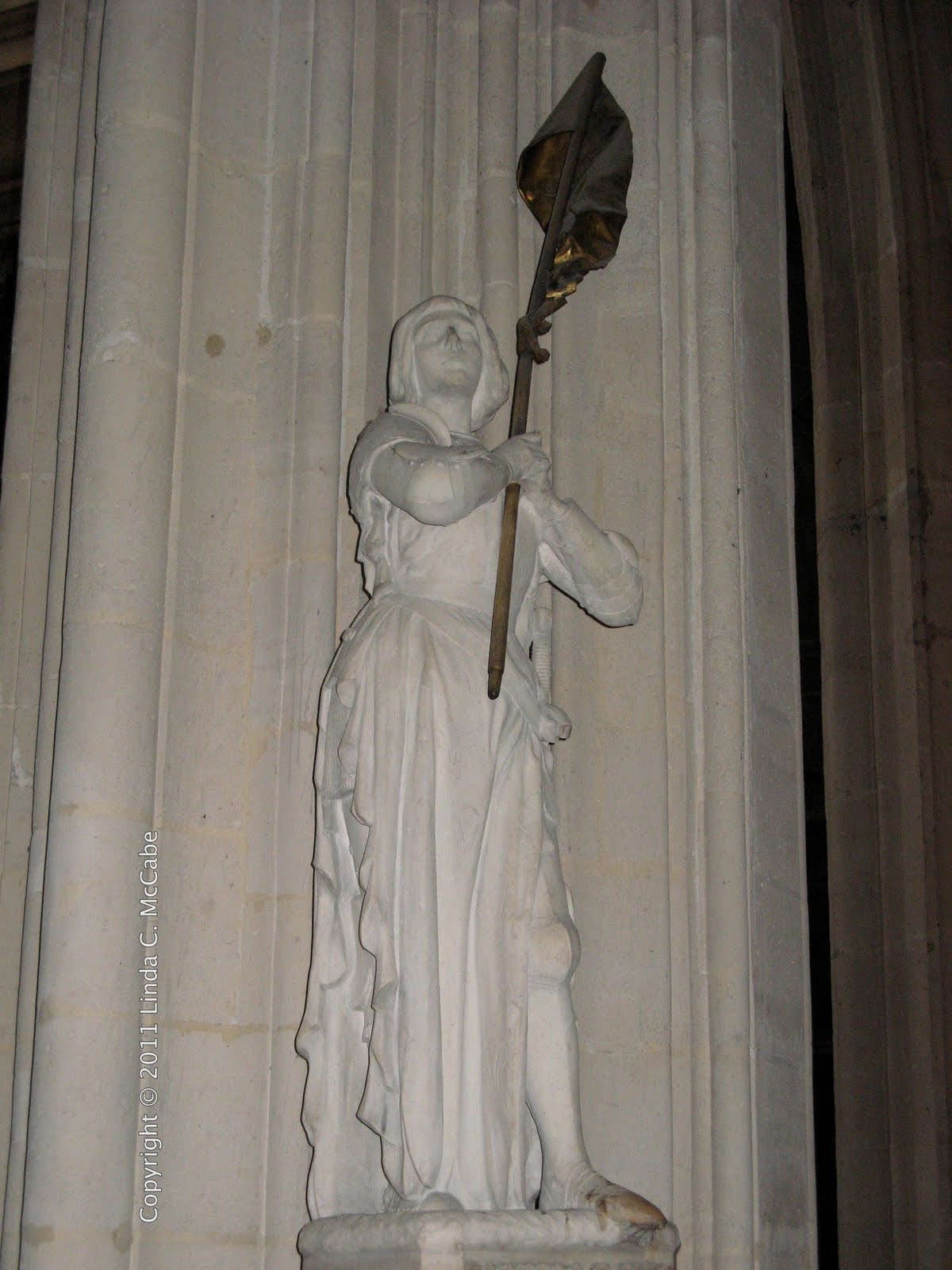
Jeanne d'Arc, St. Étienne Cathedrale in Cahors, France

Bradamante was a young woman, most likely a teenager, and is described as having a white shield with a white plume (Orlando furioso, Canto I, verse 60) and is often referred to as “the Maid.” The color white is known for the symbolic virtues of purity and innocence. Bradamante also had cropped hair, due to a blow to the back of her head by an enemy warrior near the end of Boiardo’s poem Orlando innamorato (Book III Canto v, verse 46) and a hermit cut her hair to tend to the wound. (Book III, Canto ix, verse 61)
Ariosto neglected to mention the length of Bradamante’s hair until finally in Canto 25 when her twin brother Ricciardetto relates a tale to Ruggiero of how people commonly confuse him and his sister Bradamante since they have such great resemblance to each other. The confusion about her sex was compounded when she lost her tresses due to the head injury.  (Orlando furioso, Canto XXV, verses 22-24)

Bradamante also disguised herself as a man when she approached the thief Brunello at an inn and sought to have him serve as her guide to find where Ruggiero was being held captive.

“Name, sex, race, family and place of birth
She hides, watching his hands for all she’s worth.” (Orlando furioso, Canto III, verse 76)

The greatest differences between Bradamante and Jeanne d’Arc is that the literary heroine is revered by her king, never accused of heresy, has a love life, and a much better fate than the historical figure.

Here are more artistic renderings of Bradamante.

Illustration by Gustave Doré based on Orlando furioso, Canto III, verse 9. (Doré was inspired to begin his drawings before reading the entire poem to discover in Canto XXV that Bradamante's tresses were cut to make her resemble a boy.)

Plate 20 by Jean Honoré Fragonard of Bradamant fighting Atlante on the hippogriff.  
I happen to have purchased that image when a facsimile of it was sold on eBay. The scan is from my copy.

Of all the characters in Orlando innamorato and Orlando furioso,  my favorite is Bradamante. She is a strong heroine who rarely loses her temper. Twice she gave into seeking revenge. Once was going after Martisino and the second was Pinabel. Both times she suffered due to her lust for vengeance. In Fate of the Saracen Knight, Bradamante hears rumors of Ruggiero being romantically involved with another warrior maiden. Will she suffer if she sets out on another quest for vengeance?

--> -->

Thursday, May 17, 2012

Feminine Archetypes and Symbolism in Carolingian Legends


The following is the text of the paper I gave at the Association for the Study of Women and Mythology Conference held in San Francisco on May 11th and 12th.

Like many conferences, it was difficult to choose which session to attend because there were many topics that sounded interesting.  With that in mind, I wanted to share this online for those who were not able to hear my talk.


Deconstructing Carolingian legends to discover feminine archetypes and symbolism
Before I start, I want to get a sense of the room.  How many people here are familiar with Arthurian legends? Now, how about Carolingian legends?
I want to first give an overview of Carolingian legends for those unfamiliar with them.  The word Carolingian comes from the Latin Carolus Magnus, meaning Karl the Great, better known to us as Charlemagne. The legends of Charlemagne are just as luxurious of a source material as the legends of Arthur, but without any debate as to whether or not Charlemagne was an historical figure, he was, and the legends about him were stories created to entertain and not considered as history.
I will touch on the most popular aspect of these legends in art and drama so that you will be able have discussions with people who may only be familiar with the legends of Roland (in French) or Orlando (in Italian). The most famous of the legends of Charlemagne is the Chanson de Roland or the Song of Roland.  Written in the eleventh century by a Frenchman, it was loosely based on a real defeat of Charlemagne's army in 778 in the Roncevaux Pass in the Pyrenees.  The historical events are rendered into mythology.  There are other stories comprising the Matters of France, not all were written by Frenchmen, but they all deal with legends of Medieval France. Similarly, the Matters of Britain were not all written by British writers, but they concern Medieval Britain.


Some of the largest sources of Carolingian legend, and what I will be discussing today are two epic poems written by Italians. Orlando innamorato (Orlando in love) was written by Matteo Maria Boiardo and the first version was published in 1483 and another version with more cantos was published posthumously in 1495. He stopped writing his story when the French army invaded Italy in 1494.  He found it impossible to lionize the heroic nature of fictional Frankish warriors when real French warriors were attacking the various duchies on the Italian peninsula.
A decade or so later, Ludovico Ariosto was commissioned by the same patrons to continue Boiardo's unfinished tale.  Ariosto's Orlando furioso (Orlando enraged) became more famous than its predecessor and was first published in 1516, so we will soon be celebrating its five hundredth anniversary.

Those poems were pure fiction and written to entertain and flatter the poets' patrons the noble house of Este in the northern Italian city of Ferrara.  The stories depict wars that never took place between Christian and Muslim armies and were undoubtedly influenced by the Crusades, which occurred centuries after Charlemagne's death in 814.
The two poems follow the title character of Orlando, a famous paladin of Charlemagne, and his unrequited love for Angelica the princess of Cathay.  Once Orlando discovers that Angelica has married another, he goes insane.  The story has multiple interweaving plotlines and numerous disparate settings from Europe and North Africa to Asia.
Boiardo's epic featured an invasion of the Frankish Empire by the North African Muslim army and the war was finally finished in Ariosto’s tale.  There were brave knights, scoundrels, bloody sieges, enchanted realms, sorceresses, wizards, a flying hippogriff as well as the brave female warriors, Bradamante and Marfisa.
These stories inspired many artists such as Doré, Fragonard and Ingres. There was a special exhibit in 2009 at the Louvre in Paris featuring the art inspired by Orlando furioso. There are also at least a dozen operas that cover portions of Ariosto's masterpiece. Cervante's classic novel Don Quixote includes mentions of the poem and William Shakespeare even borrowed a dramatic set-up from the fourth canto of Orlando furioso for a scene in his famous comedy "Much Ado about Nothing."


 Most people who are somewhat familiar with these stories know of Orlando's love and madness, but they are not as familiar with Bradamante's story which began as a subplot, but wound up becoming front and center in the story at its conclusion.  In Italian, her name is pronounced Bradamanté, whereas the French pronunciation is Bradamante.  Because she is a Frankish character, I use the French variant, but both are correct.
I feel Bradamante should be as famous and as well examined a character as Guinevere, Morgan le Fay and the Lady of the Lake.
The first time I read Orlando furioso was nearly ten years ago and I was startled to discover such a strong female character in literature. I had a hard time believing that this feminist character was written centuries ago, by a man, and I wondered why I had never heard of her before.
I see Bradamante as being a blend of two similar archetypes:  Joan of Arc and Athena.  Bradamante is depicted as riding on a white horse, bearing a shield and plume of white, having cropped hair and disguising herself as a man.  She also has the nickname "The Maid."  Since Joan of Arc was killed in 1431, it is reasonable to think that Boiardo and Ariosto were inspired by this real life heroine as they were writing their fictional heroine.
The major difference between the Maid of Orléans and Bradamante is that the fictional character was not persecuted for her military prowess, but instead heralded and valued as a military commander.  She was the niece of Charlemagne and came from a distinguished military family. Her interest in warfare was not due to hearing divine voices, but instead military duty was in her blood.  Charlemagne had also been a powerful monarch for many years before his niece was born, so unlike King Charles VII of France, he was not threatened by this warrior maiden's influence with the people.
Similar to Athena, the Greek goddess of wisdom and victory, Bradamante is depicted at the beginning to have a heart unmoved by men.  That is until Ruggiero, a Saracen warrior, performed an uncommon act of chivalry on her behalf on the battlefield.  This led to their talking to one another and experiencing Love at First Sight.  Ruggiero was descended from Hector of Troy and strove to live up to the image of his noble ancestor as the perfect knight. 
Dore's hippogriff
Bradamante and Ruggiero represent an impossible love as they are warriors on opposite sides of a holy war.  Symbolically this impossible love is represented in the story by the hippogriff, a mythical creature that is part eagle and part horse, and first described in Virgil's Ecclogues as being born of the mating of natural enemies of griffins and mares. Griffins were fierce protectors of gold and raiders rode horses in efforts to steal gold, leading to the animals' enmity of each other. Ariosto was the first author to use the hippogriff as a character in literature.
Bradamante and Ruggiero's bliss at finding one another does not last and they are soon cruelly separated.
This love story of Bradamante and Ruggiero shows an inverse on what we have come to expect with the hero cycle as described by Joseph Campbell with his thesis the Hero With a Thousand Faces.  Instead, Bradamante's story arc is more in line with the Heroine's Journey as described by Valerie Estelle Frankel.  Bradamante, a fair damsel, is given the Call to Adventure and is told she must rescue her beloved who is being held captive by a wizard in an enchanted castle.  After rescuing Ruggiero, her next task is to persuade him to be baptized as a Christian and marry her. In so doing, their union will bring forth generations of heroes who will, in time, lead to the noble house d'Este of Ferrara.
This is far different from traditional quest stories with a young man fighting evil in order to save his world from destruction.  Instead, Bradamante is told that her ultimate goal is marriage and motherhood.  There is a tragic element however, for it is also foretold that Ruggiero will be betrayed and killed before the birth of their child.
This next part is not symbolism or archetypes, but I wanted to share with you the qualitative difference in plot structure than what we have become accustomed to. While Ruggiero is the orphaned youth raised in obscurity, it differs from most stories in that there are two prophecies with divergent fates for Ruggiero.  Should he remain a Muslim, he would bring about the defeat of Charlemagne devastating Christendom. These stakes are compounded with dueling magical forces trying to influence which fate will come to pass.
There are other feminine archetypes appearing in these poems that are worth mentioning.  The character Angelica, the object of Orlando's romantic obsession, is described as the most beautiful woman in the world and caused every man to fall violently in love with her.  She is the archetype of Helen of Sparta (and later Troy) who was the catalyst for a war with multiple suitors vying to possess her.
Dore's Alcina
There is also Alcina, a sorceress who uses her magical powers to appear youthful.  After tiring of her lovers, she transforms them into trees and shrubs - retaining them as souvenirs of her conquests.  This echoes the story of Circe from Greek mythology.
Another female character you should know about is the other warrior maiden Marfisa.  She was abducted as a small girl, sold into slavery, and has a deep-rooted hatred of men in general.  She survived a rape attempt by her king by killing him.  She then slaughtered the king's guards until she was declared Queen Marfisa.  That was the first of many kingdoms she conquered.  Marfisa represents a destructive force of womanhood in that she conquers but does not govern. I see her as the archetype of Nemesis, the goddess of retribution.
Marfisa and Bradamante appear to be opposites at first.  Marfisa is a Muslim while Bradamante is a Christian, and they are both attracted to Ruggiero. Only when it is revealed that Marfisa is not a romantic rival for Ruggiero's affections, do the two women put aside their differences and become fast friends and allies.
These legends are also filled with symbolism. The richest symbolic scene is when Bradamante is given the Call to Adventure in a cave, recognized symbolically as the womb.  Melissa, an old enchantress, tells Bradamante of the two prophecies surrounding Ruggiero and what is expected of her.  Melissa represents the Crone.  Bradamante is a warrior maid who is being asked to become a wife and mother.  The two women together comprise the three aspects of the triple headed goddess:  Maiden, Mother, Crone.  Bradamante represents the Blade being transformed into the Chalice by the Power of Love.


National ASWM Board Member Anne R. Key and Linda C. McCabe
http://lcmccabe.blogspot.com/2012/05/feminine-archetypes-and-symbolism-in.html

Tuesday, January 10, 2012

In honor of Joan of Arc's 600th birthday

Jeanne d'Arc in the church in Saint-Antonin-Noble-Val

Joan of Arc, or Jeanne d'Arc, was born on January 6, 1412. In honor of the recent six hundredth anniversary of her birth, I present my blog readers with pictures of Jeanne d'Arc I took while on my two research trips that I took in France.

She is revered for her courage in battle defending the nation of France against the English in the "Hundred Years War" and for her faith in God.

Jeanne d'Arc is one of the patron saints of France and is a source of nationalist pride. I saw images of Jeanne d'Arc almost everywhere in France. I have come to the belief that every French village or town will have at least one image of Jeanne d'Arc. This led me to going on my own private scavenger hunt as I entered all the various cathedrales and churches.

My mission was to find her.

Sometimes she was easy to spot while other times she hid in plain sight. Here she is above the doorway and under the rose window of the church in Saint-Antonin-Noble-Val. (The first photo at the top of this post shows the close up of her.)


Here she is in the most famous church of all of France.

Cathédrale Notre Dame in Paris

I had forgotten about the famous gold statue of Jeanne d'Arc in Paris near the Place des Pyramids, and did not get my own photo of this iconic statue. I chastised myself as I watched the last day of the Tour de France and watched the cyclists pass by her multiple times.

Thankfully there is a photo posted on Wikipedia with full privileges to be in the public domain, so here is a picture of that famous golden girl.

Another representation of Jeanne d'Arc I found in Paris was in Saint-Germain-l'Auxerrois near the Louvre.

Saint-Germaine-l'Auxerrois

As I was going through my photos I discovered some duplications of statues. This same style appears in church in a small hilltop village in the Midi-Pyrenees.

-->
Église Saint Corneille in Puycelsi

And again, this time with a golden flag in Cahors. The names behind her are the men from Cahors who gave their lives in the great wars of the twentieth century.


-->
Cathédrale Saint-Étienne de Cahors

Now with a slight twist, she is holding a stone flag.

Basilique des Saints Nazaire et Celse in Carcassonne

Here is a painted version that I rather like.

-->
Église Saint Martin de Caniac-du-Causse

I also found a stained glass representation. Here she is in Amboise at the small church where Leonardo di Vinci is buried.

small church near Chateau Amboise

Then we have a wooden statue of Jeanne d'Arc which is now in the cathedral treasury in Reims. It is probably my least favorite of all the representations of Joan. She looks oh so stiff and lifeless.

Cathedral treasury in Reims


Inside the cathedral itself are mentions of her historic visit to Reims when she escorted Charles VII for his coronation.

And then across from the cathedral is a statue with Jeanne d'Arc appearing to be in the midst of battle.

Cathédrale Notre Dame de Reims

Jeanne d'Arc inspired not only the French, but she also inspired the Italian poets Matteo Maria Boiardo and Ludovico Ariosto. They patterned their heroine Bradamante after her. Both women were given the nickname "The Maid," rode on a white horse and wound up cropping their hair.

Thankfully, Bradamante did not suffer Jeanne d'Arc's fate of being persecuted, arrested, and executed as a heretic. Another major difference was that Bradamante was respected by her king and was not looked at as a threat. It also helps that Charlemagne was coronated long before his warrior niece was born.

Part of my fascination with Jeanne d'Arc is her iconic representation of a woman warrior while still projecting her humanity as well as femininity.

I wish that I had found images of Bradamante as a French heroine throughout France, but instead had to settle for Jeanne d'Arc. In another post, I shall share with you the images of Athena I found throughout France showing more examples of the archetype of the warrior woman.

I want to thank Jeff Sypeck for cluing me into this important anniversary while showing that a statue of Jeanne d'Arc in Washington, D.C., (a duplicate of the one outside Reims Cathedral), has been restored to her full glory with a new sword and a good scrub.

If you have any thoughts about Joan of Arc I would love to hear them. Even if you happen to believe, like those excellent dudes Bill and Ted, that she used to be Noah's wife.

Edited to add: I now have a board on Pinterest dedicated to Jeanne d'Arc (or Jehanne). It is ever expanding with images of this amazing saint.


http://lcmccabe.blogspot.com/2012/01/in-honor-of-joan-of-arcs-600th-birthday.html

Wednesday, December 31, 2008

Light a candle to your favorite saint

I came across a nifty little website which allows you to light a candle on behalf of the Catholic saint of your choice.

They even have my favorite obscure hermetic saint associated with Charlemagne, namely Saint Namphaise (or Namphasius) as well as Saint Roch, the patron saint of dogs and pestilence.


Simply fill out an online form, an email will be sent to your chosen recipient and a virtual candle will be lit on their behalf for sixty days.

Some saints have but a scant number of candles lit, but others such as Saint Genevieve have multiple pages of candles. I expected to find dozens of candles lit for Joan of Arc, but alas there was none.


Until I lit one.

Enjoy lighting virtual candles to your favorite saints.

And may everyone have a wonderful new year filled with joy, good health, and prosperity!

Linda

Tuesday, October 14, 2008

Carcassonne, Basilica of Saints Nazarius and Celsus


In the last installment of my travelogue series, I promised to blog on the church in the medieval walled city of Carcassonne. I wanted to do that separately since I had enough material and pictures to warrant its own post.

The church goes by a few different names. Here is the sign posted outside its entrance declaring that it is the Basilique des Saints Nazaire et Celse.


The English language handout I acquired inside gives the name of the Basilica of Saints Nazarius and Celsus. Unfortunately they did not have anything detailing the stories of those saints, but I found a lengthy tale online from a Catholic forum. Another online source has Saint Nazarius as being an abbot during the time of Clotaire and is said to have "attacked the heathendom on the southern coast of France."

The handout suggests that the earliest church on that site was built during the 6th century during the "reign of Theodoric, regent for the Kingdom of the Wisigoths (sic)." It then states that the first written mention of this church was in 925 when Bishop Gimer was transfering the "Episcopal See from St. Mary and Savior's church in the surrounding country, to the church of St. Nazaire with the city walls."

The church has been renovated many times and it is said Pope Urban II stayed in Carcassonne for five days in June 1096 after having made his infamous call for the crusades in Clermont. While in Carcassonne, he blessed the materials that were used for the Romanesque building.

The plan called for a single nave, 2 side aisles, an apse with 3 chapels and the transept. The Romaneque nave adopts a disposition frequently observed in churches of the Bas-Languedoc: Barrel vaulting with doubled arches (nave), and barrel vaulting again for the especially narrow side aisles. The 2 side vaults act as buttresses for the central vault.

Here you can see the narrow barrel vaults on the side aisles.


The handout also points out that visitors should note the alternating round and squared columns.


The history of France, and particularly the south of France, is of a series of conquests. After the defeat of Carcassonne by Simon de Montfort, the king of France wanted this Romanesque church to be replaced with a Gothic one. However, the funds ran low and rather than tear down the entire structure, it was amended.

Here is my favorite picture as it shows the seams of where the pointed Gothic arches meet the rounded Romanesque arches.


Outside the church you can see that there are still remnants of it being a "work in progress." The scaffolding alone suggests that they are actively trying to restore aspects of the edifice.


But inside you do not get the sense of construction. It is a place of worship and quiet contemplation.


Here is a picture of the North facing rose window which dates from the 13th century.


Here is another shot at a slightly different angle showing off the architecture of the building more.
Here is the South facing rose window which dates to the 14th century.

More beautiful stained glass.


Then on the floor I saw this tombstone. The handout has several mentioned, and so I am unsure who this image is supposed to represent.


Here is a baptismal font in front of a statue of Jeanne d'Arc.


And a close up of the Maid of Orleans.


This church remained a cathedral until 1803 when the Episcopal See was transfered to St. Michael's church in the modern Carcassonne. Later Pope Leo XIII made St. Nazaire into a Lesser Basilica.

Next in my series will be the hilltop village of Puycelsi overlooking the vast Forêt de Grésigne.

Tuesday, August 26, 2008

St. Antonin and the Gorgeous Aveyron Gorges


When I last left off of my travelogue describing my trip to France I was in the village of Saint-Antonin-Noble-Val. I had mentioned its origins dating back to the time of the Romans and included the ruins of a monastery said to have been chartered by Pepin le Bref, better known as the father of Charlemagne. I had not finished covering all that I wanted about Saint-Antonin-Noble-Val, but when Blogger started acting up again, I began worrying that I might have another eaten post so rather than risk losing everything and I promised to finish it on another day.

Today is that day.

First off, I'd like to go back to the village. Michelin Green Guide to Languedoc Rousillon Tarn Gorges there was a mention of two houses of note on Rue Droite due to their keystones.

The late - 15C Maison de l'Amour (House of Love) where a man and woman are depicted chastely touching lips, and the Maison du Repentir (House of Repentance) where, in contrast, two faces are shown turned away from one another.


Here are pictures of those keystones.


Here is a picture of one of the oldest houses with a plaque denoting it dates back to the 15th century.


I love seeing how old buildings have been retrofitted for different purposes. Here you can see how archways have been bricked up to create a wall.


The steeple of the main church can be seen before you even cross the bridge over the Aveyron River.


According to the literature from the Tourist Office, the church is "19th Century neo-gothic, begun in 1862 from the plans of Theodore Olivier and consecrated in 1872."

It has a beautiful façade with gargoyles.


Inside are lovely stained glass windows.


Here you can see the pointed neo-gothic arches dappled with colored light from the stained glass. Look closely you will see an Occitan cross.

Here it is close up. We did not realize the significance of this symbol until later in our trip. It had been the standard of the Counts of Toulouse and you see the Occitan Cross everywhere in the Midi-Pyrenees and in Provence as well.


What would a church in France be without a statue to Jeanne d'Arc?


The town was named Nobilis Valis during the time of the Romans due to the confluence of the Aveyron and Bonnette rivers. Here you can see the peaceful Bonnette that a woman is climbing down to test the waters.

Now come the Aveyron gorges that we saw on our way back to our rental cottage in Montclar-de-Query. Just note in the following pictures how the color in the stone changes from being stark white to gray to streaked with orange. Those colors will show up in the stones used for construction.


One of the roads we traveled was what I consider to be a one lane road. As you can see it has no lines denoting any lanes, and it had two way traffic. This would have been a "C" road that my husband and I began referring to as paved goat paths and we felt that the letter C rather than signifying that it was a county road was instead chosen for chevre or goat.


That Sunday after we attended the farmers market in Saint-Antonin-Noble-Val, we came home for a nice leisurely lunch utilizing the fine fresh produce we had acquired.

I am blessed with a husband who is an excellent cook and he spoiled me on this trip. Here was our luncheon table.


And a close up a plate of fruit, cheese, olives, and freshly made bruschetta.


We then relaxed, had a nice afternoon nap and began pouring over guide books to plan the adventures of the coming days.

For an appetizer we noshed on the local favorite Chasselas grapes as well as a plate of heirloom tomatoes, mozzarella cheese, fresh basil and a reduction sauce of balsalmic vinegar.

Here I am ready to enjoy a fine dinner that will be accompanied by a bottle of champagne from Canard Duchêne.


Then for dinner he made roasted herb and garlic chicken.

Here is a quick recipe he gave me to share with you:

Mix olive oil, mashed garlic and herbs such as basil, rosemary and oregano, then pull up the skin and push the mixture under the skin.

Rub any remaining herb/garlic/oil mixture on the outside the the chicken. Grill with indirect heat.

(A note about how to do that:

You get the coals very hot, then push to the sides. There shouldn't be a large amount of red hot coals DIRECTLY under the chicken, hence indirect heat. The reason is the outside of the chicken will cook too fast yielding burned outside and under cooked middle.)

This is the outdoor cooker he used. The bag of charcoal was incredibly light because it is made with a different process than that in the United States.


Here is his roasted herb and garlic chicken accompanied by fingerling potatoes with garlic as well as haricots verts.


It was a wonderful end to our first full day in the Midi-Pyrenees.

Next up on my travelogue is the medieval walled city of Carcassonne.