Showing posts with label Saint Namphaise. Show all posts

Wednesday, December 31, 2008

Light a candle to your favorite saint

I came across a nifty little website which allows you to light a candle on behalf of the Catholic saint of your choice.

They even have my favorite obscure hermetic saint associated with Charlemagne, namely Saint Namphaise (or Namphasius) as well as Saint Roch, the patron saint of dogs and pestilence.


Simply fill out an online form, an email will be sent to your chosen recipient and a virtual candle will be lit on their behalf for sixty days.

Some saints have but a scant number of candles lit, but others such as Saint Genevieve have multiple pages of candles. I expected to find dozens of candles lit for Joan of Arc, but alas there was none.


Until I lit one.

Enjoy lighting virtual candles to your favorite saints.

And may everyone have a wonderful new year filled with joy, good health, and prosperity!

Linda

Wednesday, November 12, 2008

Katherine Neville, Saint Namphaise, and Chain Mail

Katherine Neville speaking at Readers Books in Sonoma, California.


Yesterday I had the pleasure of meeting one of my favorite authors, Katherine Neville. Her debut novel The Eight has the distinction of being the first hardcover book published by Ballantine Books twenty years ago.


Ballantine wanted something special to have that honor and The Eight certainly fulfilled their wildest aspirations as it has been translated into thirty six languages and is a reliable back-list title. It is a book that was difficult to pigeonhole into a single genre when it appeared on the literary scene in 1988 and to this day still flummoxes people wanting to slap a convenient label on its cover.

The Eight is a complex novel set in two different parallel time frames; one is during the French Revolution and the other in the 1970s in New York and Algeria. The extensive cast of characters - some historical figures and some purely fictional - are obsessed by a mythical chess set that once belonged to Charlemagne and is reputed to bear a secret formula for power.

Chess also serves as a powerful metaphor to describe the intricate moves and counter-moves in the plot.


The long awaited sequel The Fire has a similar structure of two parallel plot threads set in different times. The contemporary time frame is at the beginning of the Iraq War and set in Colorado and Washington, D.C. and the historical time frame is set at the brink of the Greek war of independence and set in Asia, Europe and Africa.

Once again Neville has created a novel filled with intrigue, puzzles, mystery and betrayal.

Here's the book trailer:


Neville regaled us with discussing her books as well as her time spent as an employee of Bank of American in San Francisco and lived in nearby Sausalito. She fantasized about using their computer system to steal billions of dollars from her employer and did that through fiction. There were several retired BofA employees in the audience who had shared some stories with her before her talk.

I was interested to know how much chess she played since both novels are drenched in chess as well as literary alchemy. She said that she learned to play chess when she was eighteen and admitted that she gets "chess blindness." That strategic weakness wound up appearing in her sequel as her heroine became so wrapped up in a game that she did not realize she had beaten her opponent.

Neville then discussed how she has heard from many chess grandmasters including Susan Polgar the first woman to break the grandmaster gender barrier. After Katherine had turned in her manuscript, she read Polgar's memoir and wanted to change one small detail of changing the final move in a chess game. Instead of something good, she wanted the perfect move that would echo a move Polgar made in order to earn her status as grandmaster.

The bad news was that the book already had the Advanced Reader Copies printed. However, Katherine later read the ARC and discovered that three and a half pages were missing.

Missing.

This time they had to stop the presses to add in the accidentally excluded three and a half pages. And since they were doing that...she was able to get them to change the text to reflect her preferred chess move.

She said they had to include an addendum to the reviewers who received the ARCs so that they had the missing pages.

At least the printers did not spell her name wrong on the spine of the book. A few months ago Kristin Nelson had a post on her blog written anonymously by an editor that realized after a book was printed and sitting on the bookshelf in her office that an author's name was misspelled.

Oops.

That mistake brought about the pulping of 40,000 paperbacks, but thankfully they had not been shipped to any stores when the error was discovered.

Kristen Nelson had also blogged about clients of hers who discovered by checking early copies of that an uncorrected proof copy had mistakenly had gone to print and another client discovered an editorial question embedded in page 110 of the ARC that had somehow not been deleted.

Double yikes.

The good thing to take away from those stories was that the publishers were willing to make things right.

Anyway, back to discussing the books signing. It was my pleasure to meet Katherine and schmooze with her about writing, historical fiction and Charlemagne.


Her website has been retooled and it is filled with lovely extras such as podcasts where she discusses various aspects of the books and research methods. There is also a contest to win signed first editions of The Eight and The Fire. You can also check out her events schedule to see if she will be coming to a bookstore near you.

Unfortunately it only lists those signings in the United States at this time. She mentioned she will be traveling to Spain where The Eight has been listed as one its top ten books of all times - and that includes books by Cervantes!

One thing that she mentioned in her talk (and is also in the podcast about research) is how she would discover serendipitous facts that influenced her writing. These things happened so frequently that she came to expect them.

My friend Molly Dwyer spoke about this same phenomenon at the most recent meeting of my writers club.

Rob Koslowsky's write up of Molly's talk included this:

One technique (Molly) employs is to find a historical legend to resolve problems in developing the narrative and “make the writing work.” Solutions to problems will appear as you write, especially if you believe in meaningful coincidence – synchronicity. “Allow coincidences to inform your writing,” she insists, and “as you open up your writing, an upwelling of the collective consciousness occurs.” She gave an example of researching Sainte Geneviève, the patron saint of Paris, and discovering that January 3rd is her feast day and that is the date of her lead character's death. It was a significance she could not plan, but worked perfectly for her story's needs.

In fact, that kind of synchronicity is how I discovered Saint Namphaise. There was a hermit used in Ariosto's Orlando Furioso that was not given a name. During the writing of my adaptation, I felt uncomfortable having a character on the page for so long without a name. I decided to find a name for him and went to an online Catholic directory of saints hoping to find something with some symbolic significance.

After plugging in the term "hermit" in the search function for saints I was surprised to find there were over 500 listed. I started reading them in alphabetical order and thought finding a name would only take a few minutes. That is until I realized they had brief biographies I kept reading. And reading.

Some would call it procrastination, but I could not just settle on a name without searching for the "perfect one." Then I came across the listing for Saint Namphaise.

Today is also Saint Namphaise's feast day so I am frantically trying to finish this blog post while it is still November 12th.

According to legend, this obscure saint was once a soldier serving Charlemagne before dedicating his life to serving God. I am trying my level best to rescue this saint from obscurity and would like to re-post some of my favorite pictures associated with Saint Namphaise in honor of his feast day.

First is the marker denoting the site where he once helped build a monastery.


Here is my favorite photo taken during our trip to France which shows the mystical waters of the Gouffre de Lantouy near Cajarc.


Gouffre de Lantouy

This is the first real vision we had of the abbey in ruins showing arches and more than just a pile of rocks.


I hope that others will join me in celebrating this largely forgotten hermit saint associated with Charlemagne.

And for my medievalist readers, I wanted to mention that there is a contest to win chain mail by Orbit Books to promote the release of the book The Company by K.J. Parker. The contest ends on the morning of November 24th, so enter today. Hat tip to Andrew Wheeler.

There is also a post about a successful book launch for Geri Westerson's Veil of Lies which included two men in armor from Imperial Knights of Norco, California performing a bit of swordplay. I like that kind of creative ideas for book promotions.

Lastly, I wanted to point out that this is my 100th blog post and is nearing the second anniversary of when I started this literary blog.

I know many bloggers update far more frequently than I do, but I have chosen the path of having more substance to my posts over frequency. For those interested in following my blog I hope you will take advantage of the RSS feeds to be alerted for updates.

Cheers to Saint Namphaise - my favorite obscure French saint.

Monday, November 12, 2007

November 12th, Saint Namphaise Day

According to some online Catholic directories, today is the Feast Day in honor of Saint Namphaise.

Of course, with the sheer number of Catholic saints who were canonized over the years, he is not the only saint honored on November 12th. I doubt that there will soon be a movement for cities to hold parades like they do for good old Saint Patrick. Regardless, I shall raise a glass of wine tonight in tribute to my favorite hermit saint. I shall also remember the day that I scrambled around the ruins near the Gouffre de Lantouy that according to legend were once associated with Saint Namphaise.


I have been out of town, but now that I am back I hope to be able to finish my blogging on Paris. There still is so much more that I need to chronicle about my travels while my memory is fresh.

À bientôt!

Linda

Tuesday, October 16, 2007

More on Saint Namphaise and Polnagreff

The technology of the internet is a powerful thing.


Soon after a reprint of my blog posts on Saint Namphaise were published on the French Entree website I received an email from an owner of a Bed and Breakfast near the village of Pradines (close to Cahors). She was inspired to do some investigating on her own.

First thing was the strange statue in the courtyard of Hotel Dieu. It seems that its exterior changes each year with the graduation of each medical school class.

That makes sense to me now. Medical students have a strange sense of humor, I have known enough of them over the years.

She also looked into what she could find on Saint Namphaise and was gracious enough to allow me to reprint her message on my blog. She found an academic article about him as well as photographs of statues and paintings of him. Unfortunately, I did not find any of that artwork on my trip and so I do not have the rights to them.

You can however, click to view them. (There are links to photos with the academic article as well.)

I realized after reading her message that I forgot to say how Saint Namphaise died in my last post about him.

He died tragically as most good saint stories demand. You simply must be martyred in some gory manner and he did such a death. He was gored by a bull.

The hammer he held in his hand that flew into the air obviously did not help him survive such a close encounter with a horned bovine.


Here is her email message:


Hi Linda,

I was totally amazed at your chasing saints in Quercy ! I happened to hear about it on Frenchentree website. From there, I visited your most interesting website. Congratulations on your finding that hotel in the Hotel Dieu Hospital. We are Parisians and had never heard of that hotel.

Now, I felt sorry not to understand the reason of that strange statue in the hospital courtyard. So, yesterday I wrote to the hotel and here is the answer I got today :

Bonjour

merci pour votre message.

concernant la statue, à l'origine elle représente un célèbre chirurgien, Dupuytren. Elle est régulièrement redécorée par les étudiants en médecine. Cette année ils ont choisi de lui donner l'allure du célèbre chanteur Polnareff et l'ont intitulé Polnagreff en raison des différentes greffes pratiquées à l'Hôtel Dieu.

en espérant avoir répondu à votre demande,

cordialement

Catherine Jarrige

So, now we know that's this statue of the famous French surgeon Dupuytren is redecorated every year by medecine students. This year they gave it the look of Polnareff and made a pun on words because of the greffs !

Concerning Saint Namphaise, although I'm far from being passionate by history, I became very interested by your research through French little roads. And I thought maybe you didn't get all the information you might have wished to find because you looked at Google.com and not at Google.fr with "French" as your preferences. Here is what I found :

the legend

more serious from the Historical Society of the Lot

very serious again from the CNRS (centre de recherche scientifique) (in fact it's the same thing!)

When St Namphaise was digging lakes

the story of St Namphaise : (the article was written almost at the time you were in Cajarc ! you might have met the webmaster Christophe Laurens.)

in the blue part about the digging

the official church monography

a very funny article where we learn that your saint was able to cure epilepsy

a few lines about Quissac

the photo of his statue !

Incredible ! do you know that he was killed by a bull ? (read at the end, "à gauche")

another beautiful picture

some more about the crypt

there is even a book telling this story but unfortunately it seems the sale on e-bay is over

Well, it was very exciting to look for all these documents, I just hope it might be of some use to you.

Now, just a few lines to tell you who I am.

I live half the year in Pradines, near Cahors and half in Paris. I am now a retired English teacher and with my husband Francis we run a B & B, and love to welcome foreign guests. I was born in Senegal where I have lived for 22 years. I also lived in Britain, in California and in Brazil.

If ever you come back to France, we'll be delighted to meet you. My husband doesn't speak English but I can imagine you're going to improve and anyway you can communicate with few words, can't you. I loved your description of your effort in French !

All the best for your book.

Kindest regards.

Agnès Sevrin-Cance

Agnès et Francis Sevrin-Cance
Chambres d'hôtes Téranga
notre site : www.chambresteranga.com

Her website looks wonderful. If anyone is inspired to want to follow my footsteps, you might want to stay at her place. I can say that the area is spectacular.


I shall try to post more on Paris soon.

Linda


Friday, October 5, 2007

Another abbey and an elusive tomb

ETA: my husband requested that I add this comment: All photos Copyright (c) 2007 Scott C. Nevin and Linda C. McCabe, All Rights Reserved.


In my last installment, I showed you photos from our discovery of the magical Gouffre de Lantouy and its abbaye en ruines.

We left the beautiful village of Cajarc after having a fabulous lunch and continued on our journey.


It shouldn't have taken us very long, after all it was only about two inches or so on a map. However, that doesn't take into account the back country roads and the mountainous terrain.

In preparing for our trip we bought a Garmin GPS unit and a software package with the roads in France. I also bought a comprehensive, spiral bound Michelin map.

The first few days we tried just plugging our destination into the GPS and have faith that it would take us there. We soon discovered that it seemed to be possessed with the soul of HAL from 2001: A Space Odyssey. It had a mind of its own and we frequently found ourselves muttering things like, "why would it pick this road?"

Seriously, the Garmin seemed to have an affinity for roads that were little more than paved goat paths. There were times when we found ourselves on a road that was one lane and wondered why it had an aversion to roads with lanes and white stripes .

It seemed to think that all roads had the same rate of speed on them and it would calculate anything that it thought was closest to the flight path of a white winged black bird.

Except well, that led to small roads with twists and turns that while picturesque were liable to make me nauseous.

We soon started to override its itinerary by referencing the Michelin maps.

Every time we passed one of its suggested turns the unit would then say, "recalculating" in a tone of voice that sounded disappointed and just a touch irritated.

Many of the road have letters and numbers. The A roads were large, limited access, and usually we had to pay a toll when we drove on them. The N roads were large, but they didn't have the same limited access as the A roads and they were slower.

Then you had the D roads which we thought of as Departmental roads. Those came in two colors - yellow and white. The yellow were the larger and more well traveled roads. The white ones were smaller and had more of the iffy factors.

Then there were the C roads. C is for chevre or goat. Definite goat paths.

Usually it would say "turn left on D 24" or some such thing. One time the Garmin suggested that we "turn left on Road and then turn on Unpaved Road."

The fact that the first turn was an unnamed road without was bad enough, but to then suggest we then go on an unpaved road?

Hah! The driver and navigator said nooooooo.

We also tried to use road signs suggesting routes to various towns and sights. They were helpful, but we couldn't depend on them because they were not as prevalent as we would have liked.

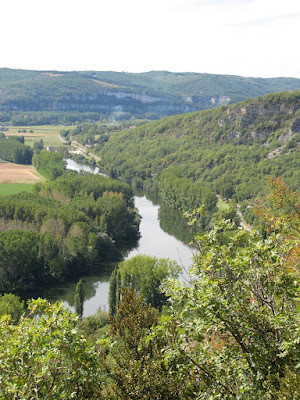
We drove along the Lot river gorges and if you've ever wondered where the word gorgeous comes from...I believe it has to come from seeing such magnificent sights.


Pretty spectacular, eh?

We slowly made our way up to Marcilhac-sur-Célé knowing that they had an ancient abbey. It was in the midst of the village and I knew that we would encounter people, unlike the abbey near the Lantouy. I did not expect to see a tour bus.

Ugh.

I doubt they were there on a pilgrimage to see sacred sites associated with Saint Namphaise, but I didn't ask either.

I went inside the tourist information office and heard a guide speaking to a group, and he was speaking in French. I knew then that it would be unlikely that he would have any time to answer my questions about Saint Namphaise and the reported link to the ancient abbey. Or to ask if there was anything standing that dated back to the eighth or ninth century.

Instead, I simply grabbed some brochures before strolling about the grounds and snapping some pictures. The abbey is definitely in ruins, and it appears that it may have been built and rebuilt at varying times over the centuries. You can notice that with the difference in styles of the arches.


Then again, there are some of the ruins that are little more than standing rock.


The translated version of the website for the town can be found here. Honestly, I don't know if any of the walls still standing might have stood when Saint Namphaise worshiped there. I suspect that those walls have long been taken down, but the stones were reused to build the later structures.


.

I love seeing the blue sky through the vacant window and non-existent roof juxtaposed with plant life growing on the walls. It gives me the feeling that the earth is trying to reclaim the man made structure.
Here's another view of archways that no longer serve their original purpose.

Our movement around the ancient abbey did not go unnoticed. A cat was perched on top of a wall out of reach, but not out of sight.


We saw this engraved on a wall and thought it was one of the most evocative images in all the churches we had visited.

There is a Gothic church next to the ruins of the abbey, but it was closed. We decided at that point to not try to find the cave Saint Namphaise was supposed to have lived in Quissac. It was getting late in the day and we still had an hour or so drive back to Monclar-de-Quercy where we were staying.

Instead, we chose to go to Caniac-du-Causse and look for his tomb. It was suggested on Quercy.net that passing under the pillars of his tomb would cure epilepsy.

I don't have epilepsy, but I sure wanted to see his reliquary. I had seen a lot of reliquaries while in France. Some large and some small.

I figured that his would probably be pretty large because I didn't think that his remains would have been in great demand from a multitude of churches, so it might have been more or less intact. Well, as intact as it can be when your death is from being gored by a bull.

We saw a sign that looked hopeful. Not only did it have the town we were looking for, but a mention of the crypt of Saint Namphaise.


We arrived in the small village and I found the shuttered tourist information office. I then walked to the town hall and showed my French print out of the legend of Saint Namphaise.

She nodded and spoke to me in French and I simply couldn't believe what she was trying to tell me. The church which happened to be next door to her office was closed.


Noooooooooooooo.

She even rattled the door to show me that it was locked. Then with a little back and forth with hacked up French and hacked up English it was conveyed that the church had an electrical problem.

Arrrrrrrgh.


I crossed an ocean and found my way to this small little village in Quercy, and I didn't get to see the pillars of his tomb.

She was nice enough however to give me a copy of their English language version of the Life of Saint Namphaise. It had a lot of similarities in that it mentioned Charlemagne, it credited Namphaise with starting the monastery near "the pit of Lantouy," and then the tragic destiny of that monastery with allegations of cooking young children bring about the destruction of the abbey.

There are some differences with the Quercy.net legend. One is that there was no mention of Marcilhac-sur-Célé, another was that the cave he was supposed to have lived in was said to be in Coursac and not Quissac.

However, I love the end of this legend for it says that "at the moment he was killed, there was a hammer in his hand, he threw it, and said: wherever it lands, I shall be buried.

The hammer bounced in Lacapellette and finally landed in Caniac du Causse."

Forgive me while I snicker. I mean, that is some Olympic record setting bounce.

That of course is what legend is all about. The town of Rocamadour claims that they have the sword of Roland from the legendary battle in Roncesvalles and that when he died he threw it in the air and it flew and landed in the side of their mountain.

That would be one heck of a throw.

Seeing that the location of Namphaise's cave is in dispute between Quissac and Coursac, (that is if he only had one and not multiple caves), I was glad that I hadn't insisted we go looking for his cave in the hope that there were some markers somewhere stating: Saint Namphaise slept in this wretched place.

Oh, and the legend she gave me also said that it was believed that "passing under the reliquary would cure sterility and recurring illnesses."

Hmmm, I wonder if it would dispense for the need of using Viagra as well.

If so, then the tourist trade would certainly pick up. That is, once they get their electrical problem solved and it is open for tourists and pilgrims to visit.

All in all it was a great day for exploring the French countryside. I never saw the tomb of Saint Namphaise, nor did I locate any chocolate éclairs. However, I did have some luscious chocolate mousse for lunch at Le President in Cajarc.

I'll tell you another story of a different place we visited in France next time.

Linda


Linda

Tuesday, October 2, 2007

Gouffre de Lantouy et la Abbaye en ruines

Or...Looking for Saint Namphaise, Part II

ETA: per my husband's request, he wanted me to place this notice on my blog:

All photos Copyright (c) 2007 Scott C. Nevin and Linda C. McCabe, All Rights Reserved.

In my last post I discussed how I set out to find places associated with Saint Namphaise. After my husband and I saw the hand lettered sign nailed to a tree telling us that we came upon "ce magnifique site" we noticed the pool of magical looking water.


There was a dry patch of land between this pool and a small stream that allowed us to walk past without getting our feet wet. I do not know if in other times of the year if those two bodies of water are connected, but if so - there was no footbridge to cross it. (Just a small word of warning should others try to follow my footsteps: you might want to bring boots in anticipation of fording a stream.)

I think this pool was the abyss mentioned in the legend of Saint Namphaise.

We walked past the water and came upon another small meadow that showed evidence of campfires. Visions of drunken teenagers hanging around flashed through my head. Then we saw a small blue arrow that had been tacked on a tree urging us to continue our search.


Here's another shot of the arrow on the tree.


We followed that arrow and found a path that diverged in a few places. I decided to follow the low lying path rather than scramble upwards. It was simply because after three weeks in France I had grown tired of climbing things and took the easy way.

That choice prolonged our discovery.

At first we came upon some stones that had clearly been some kind of physical structure, it just wasn't all that terribly impressive.


It looked like ruins, but it was hard to discern any real floor plan or anything else by it. We started assuming that this was about all we were going to see and we were a little disappointed. We had already gotten used to the idea that in France once a building goes into disuse and disrepair that its stones become prey to being re-used for future buildings. We kind of thought that it this abbey must also have been scavenged for its stone.

We walked further and found a larger path and followed that for awhile.


Then we realized that we could walk for miles and head up back in Cajarc. We turned around to return to the little stone structure but were sidetracked again by luminous water.


It was at this point that I started to get a little itchy. I knew there was more than what we first saw. I knew it in my bones.

I went back to the original structure we found and I started scrambling upon those rocks and went upwards. I started thinking, "hey, this is more like it."


My husband even snapped a picture of me with a triumphant look on my face as if to say, "look what I found."


Ah, but we were still finding the edges of our abbaye en ruines. We started going back to our car when I remembered that there were paths leading upward that I had consciously passed by.

This time I decided to follow them and see where they would lead.

Voilà.


To give you a perspective of just how small that doorway was - I crawled through it.


And then, well, here's a more triumphant look on my face.


My husband even had to grin as he sat upon an ancient wall.


We had found the monastery that according to legend was once founded by Saint Namphaise. Something was still standing. It may be in ruins, but you can still make out arches, walls, and possibly a well.

I'm not an archaeologist nor am I an expert in architecture, but unless someone definitively states that this structure had to have been from a later period of time and gives me good documented reasons - I am of the belief that a contemporary of Charlemagne once stood on that same ground. That the building was made either at the time of Charlemagne or before.

However, I do part ways from believing everything that is in the legends that I've read, particularly when it comes to the accusation of child sacrifice and cannibalism that occurred after Namphaise left the abbey.

Maybe it is because it is so horrific that I simply do not want to consider it as being reality. However, I am skeptical by nature and after having read W. Aren's The Man-Eating Myth: Anthropology and Anthropophagy I am particularly hesitant to believe that part of the legend. Arens conducted a study showing that accusations of cannibalism are far more prevalent than documented cases of cannibalism.

Accusing people of witchcraft, child sacrifice, and cannibalism has historically been done in order to condemn individuals or groups of people, and it was particularly prevalent in the Middle Ages. It was also difficult if not impossible to prove innocence, which is what the witchcraze was all about.

I will say with confidence about that aspect of the story is that there is a consistency in the tale. I also cannot say definitively if Namphaise ever was a soldier under Charlemagne. He could have been because there were thousands of men who served in Charlemagne's armies during his reign. Then again, maybe that claim about Namphaise was all about resume padding. We may never know for certain. We can only say that the legends about him includes a consistent mention of him being a former soldier for Charlemagne, and at least one source mentions the defeat at Roncevaux.

Regardless of the truth or truthiness to the legend of Saint Namphaise, it felt incredible to have that historic site all to ourselves.

No crowds.

No vendors trying to sell us something.

Nothing, but peace and quiet.

We then left in search of lunch and the next abbey associated with Saint Namphaise. Once we returned to our car we looked through the trees and saw what we had missed before.

The abbey.

Then we left Gouffrey de Lantouy, but not before my husband stated his opinion.


Next time I will show you the abbey at Marchilhac-sur-Célé and tell you about my search for the tomb of Saint Namphaise.

Linda

Monday, October 1, 2007

I went on a wild saint's chase...

I am now home safe and sound from my trip to France. It was exhausting, but very rewarding. I didn't have the computer access that I had hoped, so I wasn't able to blog while on the trip.

One of the goals I had was to find out what I could about obscure saint that I had stumbled across while doing research for my novel. According to Catholic.org there was a saint who had at one time was a soldier for Charlemagne who left his military career and devoted his life to his faith and was a hermit. His name according to that website was Namphaise, but also known as Nauphary, Namphrase, and Namphisius. I wasn't surprised by different variants of the name for many other saints depending on which language is used. For example Saint James in French becomes Saint Jacques.

I was going to use the name Nauphary since there is a town named Saint Nauphary near Montauban (which is the home of my heroine Bradamante.)

The first place I went was the town hall in the village of Saint Nauphary. I was curious to hear what they had to say about their namesake saint and was hoping that they might have something worthwhile taking a photo of such as a statue, painting, etc.

I showed a print out of the Legend of Saint Namphaise that I had found on Quercy.net. I gave her the French version and not the mangled automatic English translation version. She shook her head and told me that this story wasn't about Saint Nauphary and she underlined the portion of the page that said Namphaise and the towns he reportedly had lived in. I tried telling her that Nauphary and Namphaise were the same man, because I read that on the internet. Unfortunately I couldn't guide her to the correct page on Catholic.org which would show where I came upon that information.

She then said Nauphary was from the tenth century and had lived in Moissac. She brought out a book which gave his official history and with a little prodding, I was able to get her to made copies of that book for me.

This was all done in French.

I took lessons for a year to prepare for the trip, but I am far from fluent in the language. In fact, I think of it as speaking hacked up French. Some of my conversations with French people were done with us meeting each other on some form of common ground where those who had a familiarity with English spoke what they could and I would meet them halfway with my knowledge of some French words and trying my best to pronounce it with some level of correctness.

I was glad that I brought in the print out to the town hall, for it would have been impossible for me to convey the history of this saint without that help. I walked out of the room realizing that poor Saint Nauphary's history is being blended online with someone else who lived two centuries before him. Hopefully I'll be able to get that changed in the near future by connecting the woman from Saint Nauphary's town hall with the webmasters who have sites about the Catholic saints.

The biggest thing I took away from that day of research was that my hermit saint is no longer named Nauphary, he is Namphaise.

It was on another day that I went in search of sacred sites associated with Saint Namphaise.

I knew from previous websearches that the town of Marchilhac-sur-Célé had an ancient abbey and had seen photos of it. I also was reasonably confident I could find the tomb for Saint Namphaise in the town of Caniac-du-Causse. It was finding the monastery that the badly translated English version describing as having degenerated into a "convent of chocolate éclairs" that I was really interested in finding.

It seemed an impossible task, but then I looked again at the legend and saw a clue. There was a reference to Lantouy and the Lot valley. There was no town of Lantouy listed on my comprehensive Michelin map of France. However, when I scoured the map near the Lot River I saw the words "Gouffre de Lantouy," a symbol for ruins, and the word "monastère."

Gouffre means "gulf or abyss" in French.

I highlighted that area on the map and hoped we could find it.

The Michelin map was fabulous because it was so comprehensive, however, there are many, many roads which simply aren't well marked on the map or in real life. My husband and I began referring to the smaller roads as paved goat paths. Some were large enough to accommodate two way traffic, some weren't.

I also knew that this historical landmark would not be listed in our GPS unit. We were on our own to try and find it by map and by luck.

I decided that the best thing to do would be drive to the nearest large town and ask their tourist office if they knew of the "Gouffrey de Lantouy." So we drove to Cajarc and found that the tourist office was closed until 3 pm that day. Undaunted, I went to the town hall.


I showed a woman the print out regarding the legend of Saint Namphaise and she nodded. She spoke in rapid French, but it was evident that she knew about it! She wrote down directions of how to find the Gouffrey de Lantouy. I left the office feeling excited.

We followed her directions and soon saw the first sign telling us that indeed the site I sought was marked.


The words "Abbaye en ruines" made me feel optimistic. Further down the road we saw another sign directing us to turn right.


Then we saw a sign announcing the site. It was a bit, umm, unimpressive. The sign was rusted and bore signs of having been used as target practice.


There was no one else around. No one was asking us for Euros for admission to an historic site. In fact, besides the sign there was only a trash bin for communal trash pick up and a large area perfect to park our car. That and a small worn path to follow.

We weren't sure if this indeed was the place we sought and at first we drove on further but quickly realized after the road changed to a one lane gravel road that we needed to turn back and explore further the area around that footpath.

After walking across a small meadow we came into wooded area surrounding water and saw another sign.


In my next post, I'll show you what I found including the Pit of Lantouy.