Showing posts with label Boiardo. Show all posts

Sunday, January 13, 2019

Character study of Bradamante


Joseph Campbell famously described the commonalities of myths and stories told throughout the world as “the hero with a thousand faces” meaning that regardless of the name of the particular hero or the locale in which a monster was fought - there was an underlying mythos capturing our imaginations. That is why heroic stories persist throughout the ages and continue to be propagated for new generations. One method that allows readers or audiences to recognize the significance of what role each character plays in the story whether they are hero, ally or adversary is by using stock figures or archetypes. I use the term archetype differently than what was described by Carl Jung, so I am not limited to his set of twelve archetypes. My use is more in line with recognizing stock figures that become icons in literature and drama.


From the Ariosto Room in the Il Casino Giustiani Massimo al Laterano in Rome, Italy. Picture credit to Marco Ferrara.
Bradamante is the niece of Charlemagne and a respected warrior maiden. Ariosto praises her beauty as well as declaring her to be equal in “courage, might and expertise” to that of her famous brother Rinaldo, (Orlando furioso, Canto II, verse 31).
Archetypically, I feel that Bradamante’s character had two major influences. The first was the Greek Goddess Athena.

From the Louvre Museum in Paris.
 She was the goddess of wisdom and victory and known for her cool-headed strategic planning. No man ever captured Athena’s heart.
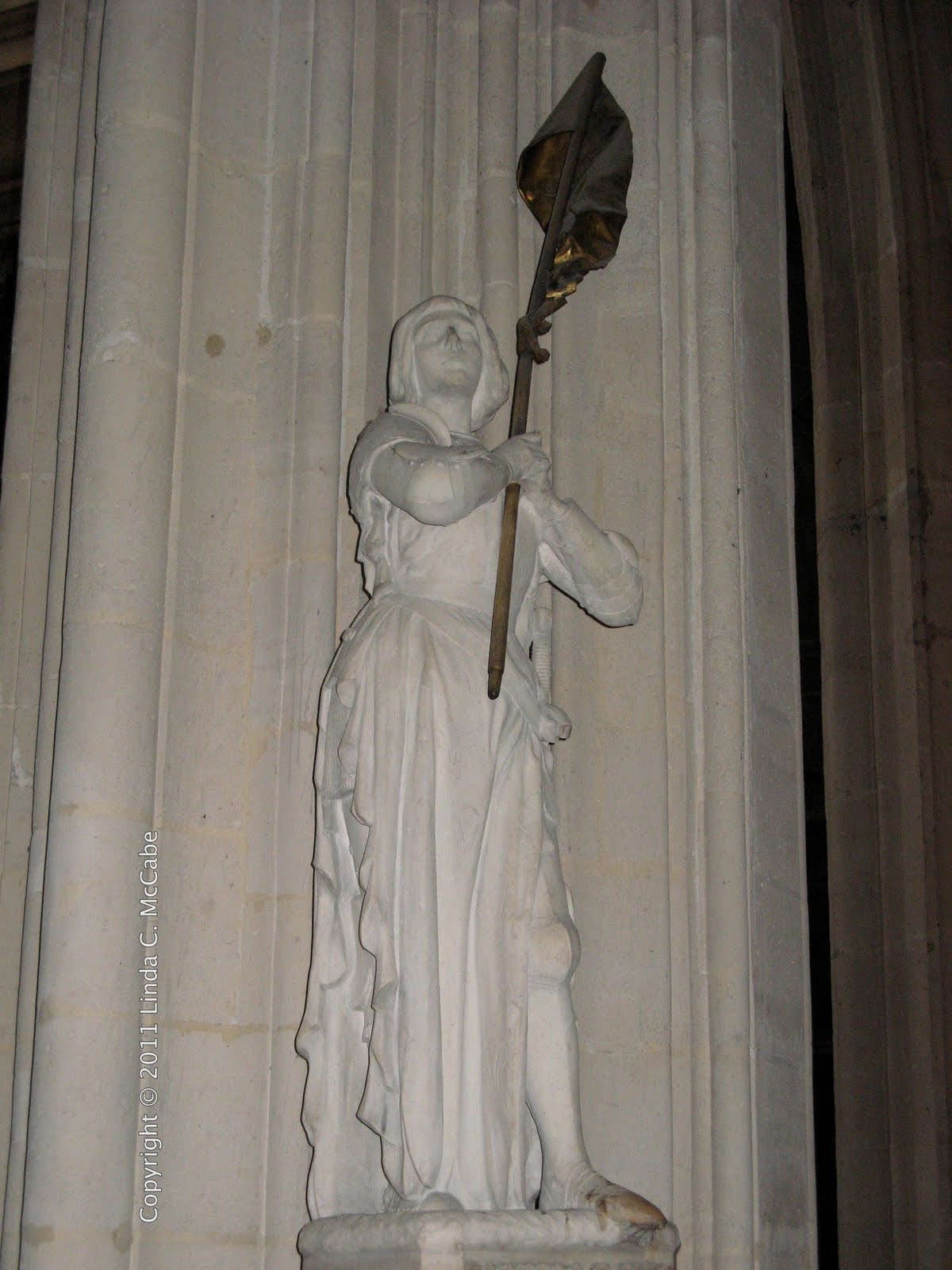
The second influence was of the historical figure of Joan of Arc or Jeanne d’Arc. I find that comparison more compelling and I feel that it was not incidental, but instead a deliberate attempt by Ariosto to invoke the parallels between the literary heroine and the real life French martyr. Jeanne d’Arc who was burned at the stake in 1431 at the age of 19. She had been known for riding a white horse, carrying a banner made of white fabric, was called “the Maid,” had cropped hair and dressed in men’s clothing.
Jeanne d'Arc, St. Étienne Cathedrale in Cahors, France

Bradamante was a young woman, most likely a teenager, and is described as having a white shield with a white plume (Orlando furioso, Canto I, verse 60) and is often referred to as “the Maid.” The color white is known for the symbolic virtues of purity and innocence. Bradamante also had cropped hair, due to a blow to the back of her head by an enemy warrior near the end of Boiardo’s poem Orlando innamorato (Book III Canto v, verse 46) and a hermit cut her hair to tend to the wound. (Book III, Canto ix, verse 61)
Ariosto neglected to mention the length of Bradamante’s hair until finally in Canto 25 when her twin brother Ricciardetto relates a tale to Ruggiero of how people commonly confuse him and his sister Bradamante since they have such great resemblance to each other. The confusion about her sex was compounded when she lost her tresses due to the head injury.  (Orlando furioso, Canto XXV, verses 22-24)

Bradamante also disguised herself as a man when she approached the thief Brunello at an inn and sought to have him serve as her guide to find where Ruggiero was being held captive.

“Name, sex, race, family and place of birth
She hides, watching his hands for all she’s worth.” (Orlando furioso, Canto III, verse 76)

The greatest differences between Bradamante and Jeanne d’Arc is that the literary heroine is revered by her king, never accused of heresy, has a love life, and a much better fate than the historical figure.

Here are more artistic renderings of Bradamante.

Illustration by Gustave Doré based on Orlando furioso, Canto III, verse 9. (Doré was inspired to begin his drawings before reading the entire poem to discover in Canto XXV that Bradamante's tresses were cut to make her resemble a boy.)

Plate 20 by Jean Honoré Fragonard of Bradamant fighting Atlante on the hippogriff.  
I happen to have purchased that image when a facsimile of it was sold on eBay. The scan is from my copy.

Of all the characters in Orlando innamorato and Orlando furioso,  my favorite is Bradamante. She is a strong heroine who rarely loses her temper. Twice she gave into seeking revenge. Once was going after Martisino and the second was Pinabel. Both times she suffered due to her lust for vengeance. In Fate of the Saracen Knight, Bradamante hears rumors of Ruggiero being romantically involved with another warrior maiden. Will she suffer if she sets out on another quest for vengeance?

--> -->

Sunday, December 23, 2018

Interview with Professor Awesome: Annotated

I had a rollicking good time talking with Professor Richard Scott Nokes over Skype on December 8th, 2018.

After finishing the interview, I realized that I had forgotten to bring up a few things I wanted to mention. I gave a lot of advice on the writing process and thought hyperlinks might be helpful for those interested in following up on them.

One aspect of the interview that makes this a little out of the ordinary was the time spent getting the tech stuff working.  We spent over half an hour trying to get the Skype application to record. After several failed attempts, Professor Nokes got it working. He started to record, but I didn't see the banner at the top indicating it was recording. I didn't want us to begin talking in earnest and have to start all over again.

I mention this because that mistake on my part is the first half minute of the video. After we stopped talking Professor Nokes spent about an hour editing the raw footage and uploaded the unedited raw footage. D'oh!

What you really missed was the cool introductory musical theme song that precedes his interviews. To get you in the proper mood, here is the music you should hear before his interviews:


And here is a re-posting of the interview with time stamps of my annotations.


At 2:04 I mention that my series is based on the legends of Charlemagne that were told and retold in the south of France and north of Italy for several centuries. For those interested in learning more, Fordham University has a website dedicated to those legends.

2:55 I mention one of the most famous contributions to the legends of Charlemagne, The Song of Roland or La Chanson de Roland. Here is a link to Fordham University's online translation and a link to Amazon.com's trade paperback version.

3:50 I show my copies of Barbara Reynolds' translations of Orlando furioso. Here are links to those copies on Amazon.com Part One and Part Two.  Those books are my preferred version of this epic poem. They are in verse and there is a lot of white space, so I find it easier to read. Guido Waldman has a one volume version, and it is written in prose. I find it difficult to read because the font is so small, and there is little white space. Here is a link to his version on Amazon.com

A free online version by Project Gutenberg can be found at this link. A fair bit of warning though. This is the William Stewart Rose translation. I started reading this epic poem by printing out a few cantos of this version and found it utterly confusing. Later, once I read the versions by both Reynolds and Waldman, I went back and checked a few choice passages. Rose refused to translate some of the bawdier ones. Bummer.

(As a side note: I do not recommend the latest translation of Orlando furioso by David R. Slavitt. That is because his publisher heavily abridged his work and deleted numerous cantos that cover the Bradamante and Ruggiero story. I disagree with the editorial decision to cut my favorite storyline from the poem, and so I cannot recommend that version. )

5:50 Professor Awesome asks me to define Saracen. Here is a link to one online definition from the Online Etymology Dictionary.

I use Saracen in my title as one of the magic terms that helps to conjure the genre, time period and meaning of the novel in as few words as possible. Fate is reminiscent of the Oracle of Delphi and those in Greek mythology trying to change their destinies. Saracen is a term that went out of use after the Medieval period. Knight is also a Medieval term used in regard to war and chivalry.

Together the three terms should help readers know this is an epic historic fantasy set in the Medieval period.

8:50 I show my copy of Orlando innamorato by Matteo Maria Boiardo, translated by Charles Stanley Ross. This is the full unabridged version by Parlor Press. Here is a link to Amazon.com's trade paperpack.

Warning: there is a previous edition by Ross that was abridged and did not include Book III of Boiardo's tale. Bradamante and Ruggiero meet in Book III, Canto iv. I was disappointed after finishing that abridged version to realize that it did not include the scene that I most wanted to read.

10:00 Discussion about fantasy elements in realistic settings.  I realize in retrospect, I didn't really answer Professor Awesome's questions about this aspect of my story.

I agree that it is difficult to strike a balance between fantasy and realism. I am retelling a story about a war that never took place between the North African Muslim army and Charlemagne's Frankish army. My goal was to make the setting feel like Medieval Europe (and North Africa) that would include historically accurate details about Roman artifacts, cultural beliefs, religious restrictions, etc. And then, there is magic, but few have the ability to cast magical spells. They are: Atallah, Melissa, and Maugis. Aistulf was given a magical book which has allowed him to cast some spells, but he is not a wizard.

For the most part, the characters live in a realistic and non-magical world, but there are times when flights of fancy come into play. The flights of the hippogriff is the most notable.

Orlando furioso included iconic visits to the Underworld and the flight to the moon by Aistulf. I had to include them, but I wanted more realism in the storyline to at least help me to "buy the premise." I feel that if I can't buy it, I can't sell it.

22:15  I mentioned writing a Master's Thesis. For anyone interested in it, here's a link to Sonoma State University's library copy of The Cultural Evolution of the Cave Man.

And here is a link to the Fifth year Harry Potter Fic that I wrote back in 2003.  It won the Readers' Choice Award for novel length story on the now defunct website Portkey.org

24:30 Question about how to begin becoming a writer.

25:15 My answer: find a writers group or club. I mentioned the California Writers Club.  My branch of that statewide organization is Redwood Writers.

Here are links to other writers groups that focus on genre fiction:
Romance Writers of America. 
Sisters in Crime.
Historical Novel Society.
Science Fiction and Fantasy Writers of America


27:00  I mentioned the challenges of getting the Point of View or POV correct. To give a little more information here is one article about the differences in POV choices. Here is a link to an article about POV violations.

And here is where my annotation, really takes off. There are many other aspects of the craft of writing that I learned over the years from belonging to my writers club. My branch has had workshops about various topic as well as talks at our monthly meetings or sessions in writers conferences. Each one of these topics is worthy of extensive blog posts or entire books.

Here are two books that I recommend:

David Corbett's book: The Art of Character 
Jordan E. Rosenfeld's book Make a Scene

Other topics that perhaps I should try to expand on as topics in the future include:

Compelling dialogue
Pacing
Plotting
Establishing setting


***One thing that I meant to bring up in my discussion with Professor Awesome, but forgot are the sheets of paper affixed with blue painters tape to the wall behind me. Those are the months of June, July, August and September of the year 802. That was one way for me to determine when different plot events took place.

The calendar was found at www.timeanddate.com This also includes the phases of the moon.  I include that information in my story. If there's a mention of a full moon, I'm not making it up. And, if I have my characters do something outdoors at night and I don't want a full moon's worth of light - I will make it rain or overcast or foggy.

Using a calendar to structure your underlying plot will give backbone to your story. I recommend all writers have a beginning day and year in mind. Then establish your timeline of events accordingly to that date. It will help you to avoid continuity errors.

I had a friend whose manuscript I read as a critique group partner. Her novel had the climax of her story being on the Thanksgiving holiday. The problem was that she had not been as careful in planning the events as she should have been and she had two Wednesdays worth of chapters. There was a line where she stated it was Wednesday, but I knew it wasn't. That's because I ground myself on the days of the week and other nitpicky details. I then gave suggestions as to how she could move certain events to still make her climactic events happen on the day she wanted.

The use of a calendar to determine the dates of plot points is something I recommend every writer use.  

The calendars on my office wall are hard to see, but the events in the months of July and August
are written in pencil, because those already took place in Quest of the Warrior Maiden. Fate of the Saracen Knight takes place in the months of July and August. The different color Post-It notes represent different character POVs that are being represented in chapters or are background information for me to know who was where and doing what on that day. For example: blue is for Bradamante, dark orange is for Ruggiero, yellow is either Renaud or Aistulf, light orange is for Rodomont or Akramont.

I tend to write one action/adventure sequence before switching to a different character's action/adventure sequence. Later, to balance the work I will shuffle the chapters together. To achieve balance, I may have to switch the days of different plot points. Having those plot points on color coded Post-It notes helps me visually re-organize and balance my storyline.

Once I start working on Volume III, I will update those calendars and create new months. ***

 32:30 I couldn't remember the name of this website that is accessible to all writers wherever you are: Absolute Write online website. There is also Absolute Write Chat and forums.

Wattpad is another global forum for writers and readers.

So if you live in a rural area and/or cannot find any writers groups in your local area you can try one of those two online websites. Go schmooze, find like minded people and engage with them.

38:30 I recommended the book Audition: Everything an Actor Needs to Know to Get the Part by Michael Shurtleff. Oops. There are twelve guideposts for actors, I misspoke and said ten. Humor is Guidepost 4. Here is a small excerpt to demonstrate why I adore Shurtleff's book and his advice.

"Humor is not jokes. It is that attitude toward being alive without which you would long ago have jumped off the Fifty-ninth Street Bridge.

Humor is not being funny. It is the coin of exchange between human beings that makes it possible for us to get through the day. Humor exists even in the humorless.

There is humor in every scene, just as there is in every situation in life. There is humor in Chekhov (too seldom found) and even in Eugene O'Neill (virtually never found). When we say about a life situation, "And it's not funny, either," we are attempting to inject humor into a situation that lacks it. We try in life to put humor everywhere; if we didn't, we couldn't bear to live." - page 53
So yes, as writers, we need humor in our writing. Even if the only humor in a scene is gallows humor.

44:30 There was a mention of Medieval Conferences. I twice attended the International Congress on Medieval Studies at Western Michigan University in Kalamazoo, Michigan. I delivered papers about Carolingian legends and Ariosto. I will be delivering another paper in May 2019 in a session organized by the Société Rencesvals. My paper is titled "To Die For: Duels by knights in Orlando innamorato and Orlando furioso over swords, horses, heraldic symbols, and women."

I delivered the paper "Orlando furioso's archetypes and the twisting of expected plot conventions" at the 15th Triennial Congress of the International Courtly Literature Society in 2016. 
Here is the website for the International Courtly Literature Society North American Branch and to Academia.edu if you are interested in seeing my paper.


( I should at some point finish writing citations of the two papers I delivered at Kalamazoo and upload them to Academia.edu. One of my papers, "Ludovico Ariosto’s Legacy: Inspiring Countless Artists, Playwrights, Novelists, Filmmakers, and Puppet Theater" was filled with images and the challenge I have is finding good online sources for those images and then go through the cumbersome process of MLA citation. That shows my work ethic that I don't want to publish a paper online without my citations being in order. That will probably wait until some rainy day when I am procrastinating from doing other writing.)


I think that's all for now.

Here's a reminder that the both Quest of the Warrior Maiden and Fate of the Saracen Knight are discounted in the month of December. If you know someone who loves reading and would like to fill their physical or digital bookshelves, please send them the gift of reading. Or give yourself a gift and be transported back to the time of Charlemagne.

Cheers,

Linda
-->


Monday, September 8, 2014

Celebrating Ludovico Ariosto's 540th Birthday

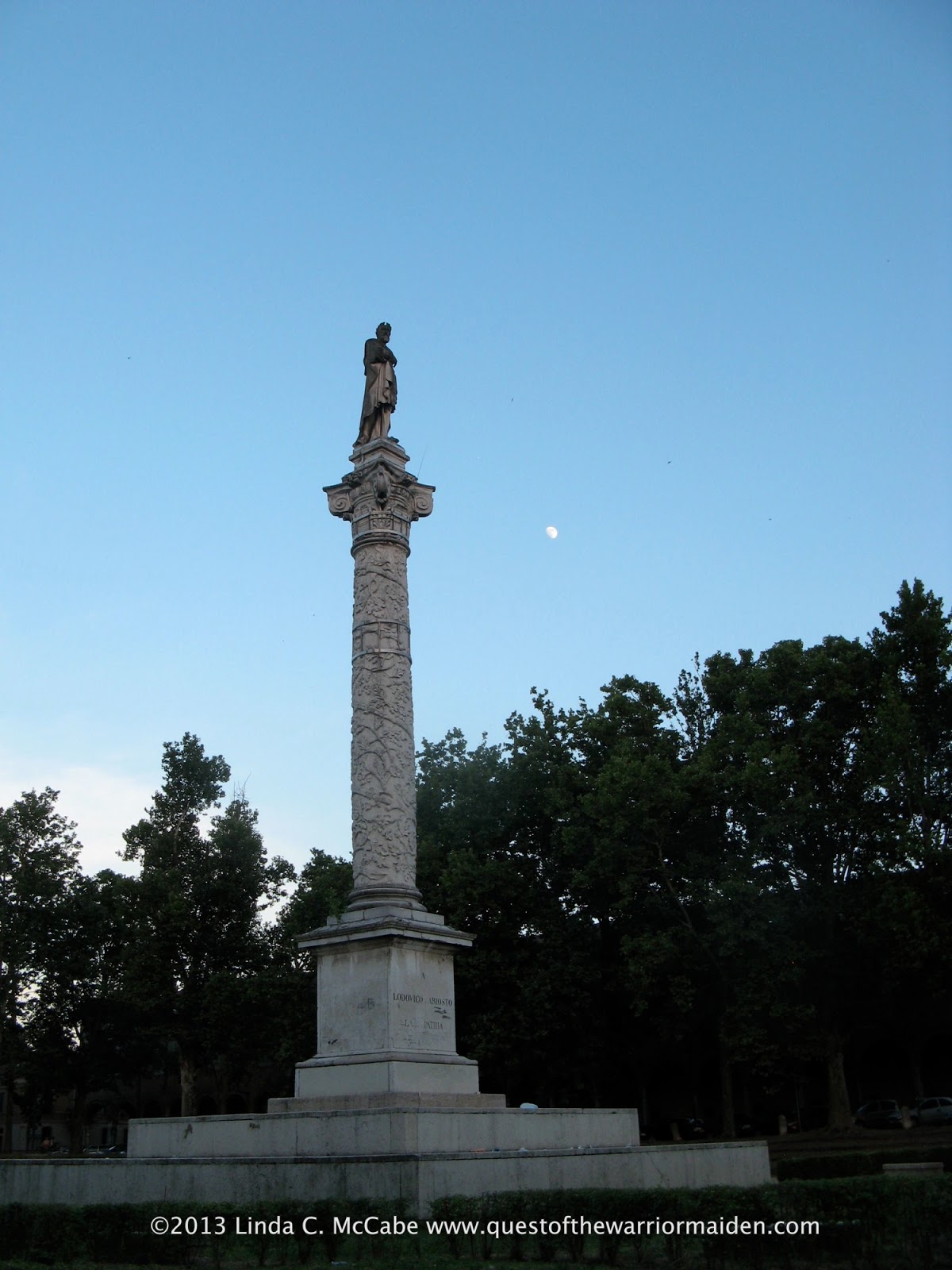
Statue of Ludovico Ariosto in the Piazza Ariostea, Ferrara, Italy

Ludovico Ariosto was born September 8, 1474


"Of ladies, cavaliers, of love and war,
Of courtesies and of brave deeds I sing..."
-Ludovico Ariosto, Orlando furioso
(translated by Barbara Reynolds)


 Last year I spent three weeks in Italy in research for my writing. The highlight of my trip was spending an entire day in Ferrara. I walked miles that day searching for sites associated with Ludovico Ariosto, Matteo Maria Boiardo and the noble house of d'Este. Having spent years adapting Ariosto's masterpiece into a series of novels for modern day audiences, I wanted to surround myself in the beauty and charm of Ferrara and to visit the places where Ariosto wrote. It was an inspirational trip and I look forward to returning to Italy, hopefully in 2016 to help commemorate the 500th anniversary of the original publication of Orlando furioso.

To help celebrate Ariosto's 540th birthday, my novel Quest of the Warrior Maiden will have a special discount price during his birthday week.  The regular sale price is $4.99 for the ebook and $16.99 for the trade paperback. For this week the e-book is only 99 cents at Amazon.com and the trade paperback at $12. The discounted price will be available until Sunday, September 14th.

Here are some links for my international friends to access a similar discount at foreign Amazon outlets.
Australia ebook
Brazil ebook
Canada ebook
France ebook trade paperback
Germany ebook trade paperback
India ebook
Italy ebook  trade paperback
Mexico ebook
Spain ebook trade paperback
United Kingdom ebook trade paperback

Please share this information with your students, friends, colleagues, anyone who enjoys epic tales of chivalry.

I am also happy to share with you some good news about my book with the following glowing review and mention of awards it has won.

"In Quest of the Warrior Maiden, author Linda McCabe reveals an undeniable talent for creating a truly memorable and epic fantasy saga incorporating memorable characters, cliff hanger suspense, magic and Arthurian romance of the first order. Quest of the Warrior Maiden is enthusiastically recommended reading and a first rate selection for community library Science Fiction/Fantasy collections." - Julie Summers, Reviewer - Midwest Book Review

AWARDS
• Winner - Best Historic Fantasy by the Bay Area Independent Publishers Association (BAIPA)
• Honorable Mention for Genre-Based fiction by the Hollywood Book Festival


For those wondering about the progress of the sequel, I am about a third of the way through. I am currently writing about Aistulf (Astolfo) chasing the Harpies into the Underworld.

My goal is to have the sequel finished in time for the 2016 Medieval Congress and all of the celebrations marking the 500th anniversary publication year of Orlando furioso.

Until then, buona fortuna!

Linda C. McCabe

http://lcmccabe.blogspot.com/2014/09/celebrating-ludovico-ariostos-540th.html

Sunday, September 8, 2013

My travels to Ferrara, Italy - Part I

Outside the cathedral in Ferrara, Italy
In honor of Ludovico Ariosto's 539th birthday on September 8, 2013, I felt I should start blogging about my recent trip to the city of Ferrara, Italy. I visited there in June of this year.

I wanted to see as many sites associated with Ariosto, Matteo Maria Boiardo and their patrons - the noble house of d'Este - as was possible for the limited time I had available.

I had spent countless hours planning the sites to see, but alas, things do not always work out the way you hope.

I discovered there were apartments for rent in a building once owned by Ariosto. I reserved a room for three nights.  My plan was to arrive in Ferrara after a day of sightseeing in Firenze, spend the next day exploring Ferrara, and the following day we would have a day trip to Ravenna.

I had wanted to sleep in a home that once belonged to Ariosto and hope I would become inspired by the experience.

-->
Historical marker for the current Cavallini-Sgarbi House


The Cavallini-Sgarbi House showing a covered walkway.
 
I was looking forward to that experience, but then Fate upended my plans.

Ferrara suffered from a large earthquake in 2012, and as luck would have it - the historical building I had reservations for wound up having maintenance scheduled to be performed during the time we were supposed to stay there.


These things happen. At least I learned about the conflict with adequate advance notice to secure a different place for us to stay. I am also grateful it was not a case of being At The Wrong Place At the Wrong Time and have something Truly Bad Happen, like the devastating earthquake that necessitated the seismic retrofitting. Instead, it was simply a disappointment and inconvenience for my family.

Here is an example of damage from the earthquake and the subsequent tremors has had in Ferrara. The picture is of a ceiling fresco in the Castello Estense.


I was surprised the first time I noticed tape on the ceiling, but then quickly understood why it was there. We asked a docent about the tape and our suspicions were confirmed as to its purpose. It is to prevent further cracking until restoration can be performed.

There was a lot of tape used throughout the castle on artwork. It serves as a sober reminder of how historical items are vulnerable to the power of Nature. They are not just pieces of art created centuries ago, but are precious items that need to be preserved for future generations.


We arrived in Ferrara on a Wednesday evening, but several hours later than we expected. Our connecting train in Bologna was late. Then again, most trains were late that day. One woman on the platform informed us that earlier in the day someone had thrown themselves upon a set of train tracks and it delayed all the trains in the region for at least an hour.

Once at the Ferrara train station, we had a taxi bring us to our B&B (bed and breakfast). It would have been a half hour walk, and dragging our luggage that far after being exhausted, and really hungry was not worth saving a few euros. Taking a taxi was a necessity and not a luxury at that point in time.

By the time we got to our room we were tired, our feet were sore from our sightseeing in Firenze and we were really hungry. The weather in Italy had been HOT for days and it added to our desire to find dinner, and go to sleep early in our air conditioned rooms.

My husband and son at that point in time were not all that interested in noticing the charms of Ferrara, but I came became revived once we left our baggage behind and started exploring the city. One aspect that I love about Ferrara is that it is a bicycle friendly city. There are cars and some Vespas, but bicycles seem to be the biggest method of transportation used by the people. They are not fine racing bikes, but instead generally old beat up bicycles with baskets on their front handle bars. They are utilitarian and get their riders from place to place over the cobblestone roads.

Rome has a frenetic energy about it which led me to the conclusion that traffic there is a blood sport. Crossing a busy street in Rome you must be wary. That sense of self-preservation extends to walking in the side streets as the drivers of cars and Vespas zoom past you with little regard to your safety. There were several occasions when I found myself hugging the walls in the back streets to avoid being hit by cars, scooters or motorcycles. Ferrara was a pleasant change of pace for me and I began to relax and appreciate the atmosphere of this historic city. 

We walked past the Piazza Ariostea and I was enchanted by the sight of a statue of Ariosto and the moon.

Here is a close up of the inscription on the statue.


That night we ate at a local pizza joint. It was "okay, nothing special." At least we were served quickly and it was not expensive. Afterward, we walked back to our B&B and slept soundly.

The next day was my day to explore Ferrara. My teenaged son decided that he just wanted to relax, sleep in and not go exploring. That meant I was free to roam around the city.

My husband and I started the morning by walking down the Corso Porta Mare and passing the Piazza Ariostea again.


I enjoyed walking in the park and gathering spot for locals that was built dedicated in honor of my favorite poet. We continued on the Corso Porta Mare until we came to Corso Ercole I d'Este, named after the patron for both Boiardo and Ariosto.


On that street is the famous building Palazzo dei Diamante. There are thousands of diamond shaped marble bricks covering the outside of this building. The shadows cast by the diamonds change during the day due to angle of the sunlight making the building a large and complex sun dial. It is a spectacular sight, even if it seems a bit disorienting at first.


An up-close image of the Palazzo dei Diamante and the Renaissance street Corso Ercole I d'Este.

My husband and I walked down the Corso Ercole I d'Este until we came to the heart of the Renaissance city. I had to make a quick stop to see a Piazza named for another poet who also worked for the noble house of d'Este.


Alas, this piazza was nothing more than a parking lot.

The Piazza Torquato Tasso


We soon made it to one of the big destinations for me: seeing the castle where the Estes family lived.

It is an impressive sight.


I shall continue my travelogue about Ferrara in another post, lest this become epic in size similar to the poems which inspire my writing.


Tuesday, January 10, 2012

In honor of Joan of Arc's 600th birthday

Jeanne d'Arc in the church in Saint-Antonin-Noble-Val

Joan of Arc, or Jeanne d'Arc, was born on January 6, 1412. In honor of the recent six hundredth anniversary of her birth, I present my blog readers with pictures of Jeanne d'Arc I took while on my two research trips that I took in France.

She is revered for her courage in battle defending the nation of France against the English in the "Hundred Years War" and for her faith in God.

Jeanne d'Arc is one of the patron saints of France and is a source of nationalist pride. I saw images of Jeanne d'Arc almost everywhere in France. I have come to the belief that every French village or town will have at least one image of Jeanne d'Arc. This led me to going on my own private scavenger hunt as I entered all the various cathedrales and churches.

My mission was to find her.

Sometimes she was easy to spot while other times she hid in plain sight. Here she is above the doorway and under the rose window of the church in Saint-Antonin-Noble-Val. (The first photo at the top of this post shows the close up of her.)


Here she is in the most famous church of all of France.

Cathédrale Notre Dame in Paris

I had forgotten about the famous gold statue of Jeanne d'Arc in Paris near the Place des Pyramids, and did not get my own photo of this iconic statue. I chastised myself as I watched the last day of the Tour de France and watched the cyclists pass by her multiple times.

Thankfully there is a photo posted on Wikipedia with full privileges to be in the public domain, so here is a picture of that famous golden girl.

Another representation of Jeanne d'Arc I found in Paris was in Saint-Germain-l'Auxerrois near the Louvre.

Saint-Germaine-l'Auxerrois

As I was going through my photos I discovered some duplications of statues. This same style appears in church in a small hilltop village in the Midi-Pyrenees.

-->
Église Saint Corneille in Puycelsi

And again, this time with a golden flag in Cahors. The names behind her are the men from Cahors who gave their lives in the great wars of the twentieth century.


-->
Cathédrale Saint-Étienne de Cahors

Now with a slight twist, she is holding a stone flag.

Basilique des Saints Nazaire et Celse in Carcassonne

Here is a painted version that I rather like.

-->
Église Saint Martin de Caniac-du-Causse

I also found a stained glass representation. Here she is in Amboise at the small church where Leonardo di Vinci is buried.

small church near Chateau Amboise

Then we have a wooden statue of Jeanne d'Arc which is now in the cathedral treasury in Reims. It is probably my least favorite of all the representations of Joan. She looks oh so stiff and lifeless.

Cathedral treasury in Reims


Inside the cathedral itself are mentions of her historic visit to Reims when she escorted Charles VII for his coronation.

And then across from the cathedral is a statue with Jeanne d'Arc appearing to be in the midst of battle.

Cathédrale Notre Dame de Reims

Jeanne d'Arc inspired not only the French, but she also inspired the Italian poets Matteo Maria Boiardo and Ludovico Ariosto. They patterned their heroine Bradamante after her. Both women were given the nickname "The Maid," rode on a white horse and wound up cropping their hair.

Thankfully, Bradamante did not suffer Jeanne d'Arc's fate of being persecuted, arrested, and executed as a heretic. Another major difference was that Bradamante was respected by her king and was not looked at as a threat. It also helps that Charlemagne was coronated long before his warrior niece was born.

Part of my fascination with Jeanne d'Arc is her iconic representation of a woman warrior while still projecting her humanity as well as femininity.

I wish that I had found images of Bradamante as a French heroine throughout France, but instead had to settle for Jeanne d'Arc. In another post, I shall share with you the images of Athena I found throughout France showing more examples of the archetype of the warrior woman.

I want to thank Jeff Sypeck for cluing me into this important anniversary while showing that a statue of Jeanne d'Arc in Washington, D.C., (a duplicate of the one outside Reims Cathedral), has been restored to her full glory with a new sword and a good scrub.

If you have any thoughts about Joan of Arc I would love to hear them. Even if you happen to believe, like those excellent dudes Bill and Ted, that she used to be Noah's wife.

Edited to add: I now have a board on Pinterest dedicated to Jeanne d'Arc (or Jehanne). It is ever expanding with images of this amazing saint.


http://lcmccabe.blogspot.com/2012/01/in-honor-of-joan-of-arcs-600th-birthday.html

Tuesday, June 7, 2011

Overview of Orlando furioso and Orlando innamorato


I thought it might be of interest for medievalists unfamiliar with the classic, but largely forgotten, epic poems Orlando inmmaorato and Orlando furioso for me to create a few posts describing the genre and include a few character sketches. These posts might also be of interest for those studying Italian Renaissance literature or fans of opera.

Arthurian legends are more famous than Carolingian legends, but I feel they are both luxurious in their dramatic potential.

The one entry in legends of Charlemagne that most people will have at least heard of is the Song of Roland or Chanson de Roland. It is an epic poem which has immortalized the real life defeat of Charlemagne's forces in the Roncesvalles (Roncevaux) pass in the Pyrenees Mountains when his rear guard was ambushed by Basque forces in 778. The circumstances of this historical event were then embellished and exaggerated by the poem and centers the tragedy on the betrayal and heroic death of paladin Roland by his stepfather the treacherous Ganelon of the house of Maganza.

The cycle of Carolingian legends proliferated in France as well as northern Italy with many different heroes and stories being added. Roland became Orlando as several of the legends had him being a son of Charlemagne's sister who eloped and fled to Italy.

Matteo Maria Boiardo began writing Orlando innamorato and incorporated many of these characters in what became a sprawling epic with multiple and interweaving plot lines with a cast of thousands. Boiardo stopped writing his masterpiece when France invaded Italy, and lionizing Frankish warriors as heroes became untenable for him. After Boiardo's death, the unfinished poem was continued by Ludovico Ariosto's Orlando furioso.

Think of these two poems as being a grand Medieval soap opera. Both poets used a convention of a narrator inserting himself into the narrative and guiding their audience from one storyline to another. "We will leave Orlando dueling with Agricane for now and turn our attention back to Ranaldo..."

It is far more complex than the simple Chanson de Roland which only dealt with one storyline.


The titles of both epic poems reflects on Charlemagne's chief paladin, Orlando, and the unrequited love he had for the beautiful Angelica. Orlando abandons his station and his duty as he departs on a desperate, obsessive quest to make Angelica his lady.

There are periods of time when Orlando is by her side defending her honor and castle, and other extended periods of time when he searches in vain for her. At no time does she return his affections, nor does she want a romantic relationship with him. Angelica manipulates Orlando to serve her needs, and deceives him into believing she has feelings for him in return. It is when Orlando discovers that Angelica has married another that he goes "furioso" and loses his mind. Only by the intervention by another paladin, under extraordinary cosmic circumstances, does Orlando regain his wits.

Orlando's infatuation and obsessive desire for a beautiful woman, which lead to his madness is a storyline that did not move me emotionally. As a woman, I could not identify with Orlando's quest as I have never allowed myself to become obsessed with someone's looks to the point where it rules my every thought and action. I also saw Angelica as being unworthy of such adulation. Yes, she was outwardly beautiful, but none of the men who were fighting over her had ever spent much time in her presence, so they did not know what she was like as a person. They simply wanted to make her their conquest and be able to claim that they had taken her virginity.

Orlando innamorato and Orlando furioso had many other plot lines of varying importance, but the one that drew my attention was the love story of Bradamante and Ruggiero. Bradamante was a warrior maid and niece of Charlemagne. This powerful woman was respected for her strategic mind and prowess in battle. She was content to dedicate her life to battle and was startled by the intense feelings of attraction after meeting Ruggiero, an enemy soldier who extended to her an uncommon courtesy. The two soldiers fell deeply in love, but were on opposite sides of a holy war and fought to overcome numerous obstacles in order to be together.

Next time I will discuss my reaction to the characters Angelica and Bradamante and compare them to the archetypes of Aphrodite and Athena.

Friday, January 25, 2008

Love Conquers All or Subjugated by Love

Yesterday Jennifer Lynn Jordan wrote a blog post regarding the director Terry Gilliam and his incredibly bad luck. There was one passage that was especially thought provoking for me. It was:


Take Brazil. Production for this film (one of my very, very favorites) sent the project into never-before-seen levels of debt, and the studio battle for the final cut was epic, spawning several documentaries and a book. Gilliam lost the Battle of Brazil. The first theatrical release had a saccharine-sweet, happy ending Gilliam never intended, as did the TV edit (now known derisively as the "Love Conquers All" version). In the end, though, he got his way with one of the best-selling releases from the Criterion Collection, which included three different cuts of the film, amongst which is the Gilliam-approved version. Unfortunately, the Criterion Collection consistently costs above $50, and the cheaper, more accessible DVD releases rarely include the Director's Cut. The result is that Brazil remains one of the most highly-esteemed, least seen films of our time.

The phrase that intrigued me was "Love Conquers All" and how it has come to be used in a pejorative manner.

I posted a reply to her there, but have since then had more thoughts on the subject and decided it would be best to expand upon them here rather than clog her comment trail with a long winded reply.

The phrase in question is first attributed to the ancient Roman poet Virgil in his Eclogues (Eclogue X to be exact.) The online Massachusetts Institute for Technology site has the entire works of Virgil's Eclogues and the following translation:

Love conquers all things; yield we too to love!
I would have liked to give a longer passage to help give an idea as to its proper context, but I did not see any real easy place to cut it. Therefore if you are interested, please follow the link if you desire to see how that phrase is the culmination of a speech.

Back to how the phrase is being used today. Commonly the phrase "love conquers all" (LCA) when used in discussing popular culture connotes that Love will somehow solve all problems and create the desired Happily Ever After (HEA) ending. Cue the violins and pass a tray of baklava.

It is not that I dislike happy endings, but I prefer endings that are satisfying dramatically. Sometimes that means that you leave the theater on a happy note, and other times it is more appropriate for a cathartic cry. I dislike endings that are like cotton candy that are light, frothy, and rot your teeth. I would rather have some vinegar to go with my honey to provide some contrast and depth in the emotions being evoked.

There is a different reading of the phrase "love conquers all" by a different poet yielding a much different meaning from the syrupy sweet ending with which it has been associated.

The Italian Renaissance poet Matteo Maria Boiardo in his epic poem Orlando Innamorato meant that the power of love surpassed all else and no one, not even the powerful knight Orlando was immune to its effects.

Here's the second stanza in the first canto in Book 1 (translation by Charles Stanley Ross):

"Don't think it strange, my lords, to hear
Orlando Innamorato sung.
It always is the proudest man
whom Love defeats and subjugates.
No strong arm, no audacity,
no blade well-honed, no shield or mail,
no other power can avail,
for in the end Love conquers all."

In other words, everyone can be struck down by the power of love or "Subjugated by Love. " That phrase has a different ring to it than "Love conquers all" and it implies that people will do anything when they are conquered by the power of Love.

Instead of scheduling a dental appointment to check for tooth rot, it conjures up an image of Aphrodite as a dominatrix or Eros decked out in leather chaps.

I do not mean the cute winged cherub that Cupid calls to mind. I mean a young virile man with six pack abs who just happens to have wings and a quiver of arrows tipped with magic. Check out your local store for some trashy romance novel covers if you need any help with that imagery, it should not take long to find a hawt male. Or you can look at the cover and review of Virgin Slave, Barbarian King to get an idea.


Imagine if the upcoming holiday of Valentine's Day which provides billions of dollars for Hallmark cards and florists were to feature powerful images of Love instead of lacy red hearts and tacky stuffed animals.

Of course that will never happen. Instead we are stuck with doilies, cherubs, and heart shaped confetti. How utterly romantic.

I shall dedicate more to my visit to Chantilly in another post, but here is a preview. There was an entire room decorated with stained glass retelling the legend of Cupido (Cupid or Eros) and Psiche (Psyche).


Here are the lovers. Cupido looks more like an adolescent child than a God of Lurve.


I shall leave you with another version of this phrase. This time I wish for you to consider the immortal words from the famous philosopher Huey Lewis:

"It's strong and it's sudden and it's cruel sometimes
But it might just save your life
That's the power of love."


Linda